Career Objective for a CV: What Should You Write to Make Recruiters Understand You?
“Seeking a professional work environment where I can learn, grow, and contribute to the company.”
Sound familiar?
There’s nothing wrong with wanting to learn or grow. The problem is that a statement like this could appear on almost anyone’s CV.
Your Career Objective takes up only a small part of your CV, but it has an important job: helping recruiters quickly understand where you’re heading and why your background makes sense for the role.
Instead of filling the space with generic ambitions, use it to give the rest of your CV context.
1. What is a Career Objective on a CV?
A Career Objective is a short introduction, usually placed near the top of your CV, that explains the type of role or career direction you are pursuing.
For students and fresh graduates, it can be especially useful when professional experience is still limited.
But a Career Objective shouldn’t exist simply to fill empty space.
It should help connect what you’ve already done with what you want to do next.
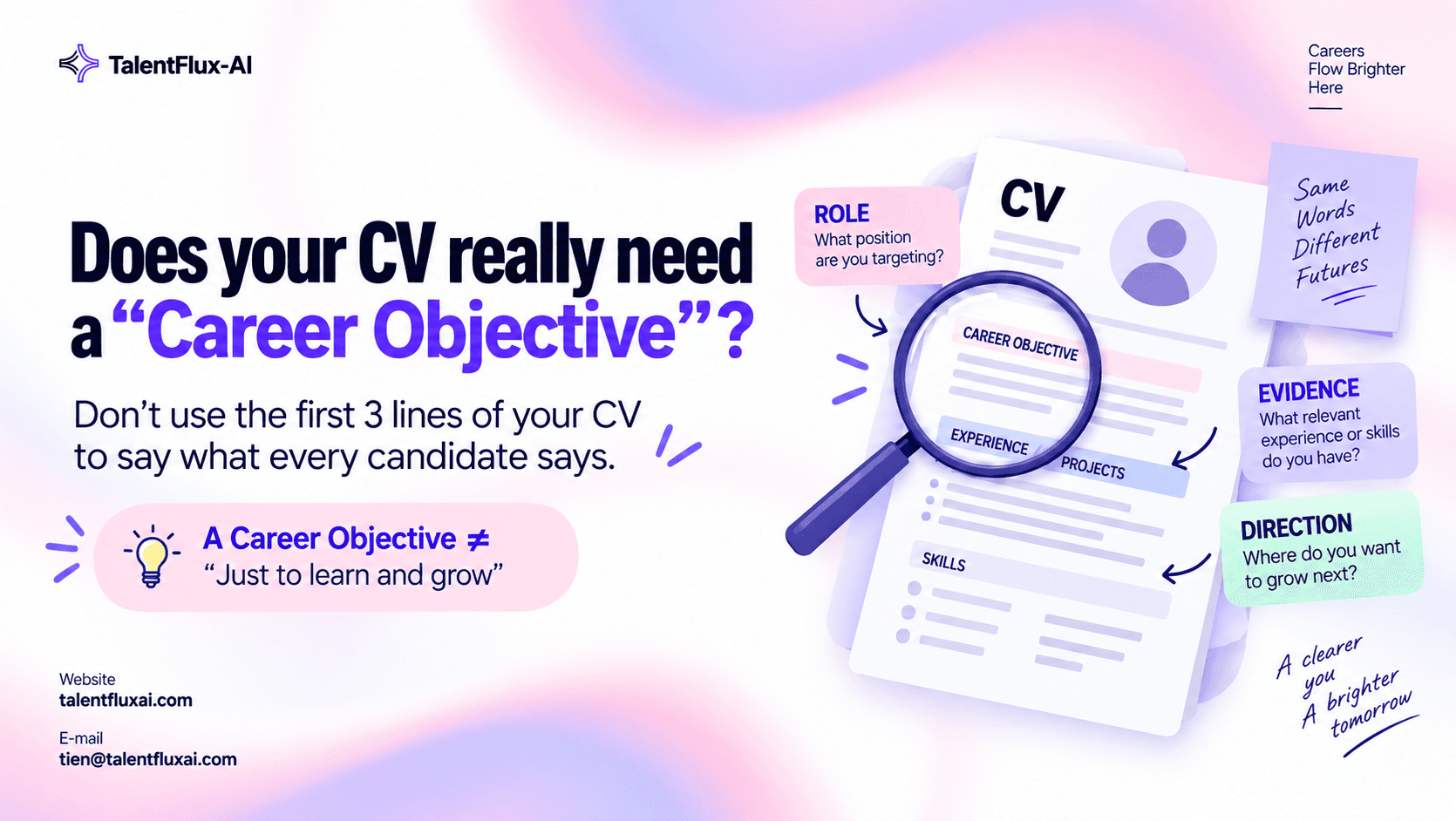
A strong Career Objective should answer three simple questions:
What do you want to do? → What relevant experience or skills do you already have? → Where do you want to grow next?
That gives recruiters a clearer lens through which to read the rest of your CV.
2. When should you use a Career Objective?
A Career Objective can be useful if you:
- Are a student or fresh graduate with limited professional experience;
- Are transitioning into a new career or industry;
- Have different types of experience and need to clarify your direction;
- Are applying for a specific role and want to establish your fit from the beginning.
If you already have substantial professional experience, however, a Professional Summary may be more useful.
Why?
Because you already have achievements, responsibilities, and results to summarize. Instead of focusing primarily on where you want to go, you can lead with the value you’ve already demonstrated.
3. A simple formula for writing your Career Objective
If you’re staring at a blank CV and don’t know where to begin, try this structure:
Current Profile + Relevant Evidence + Target Direction
For example:
Marketing student with hands-on experience in social content and campaign support, seeking to develop further in Content Marketing and contribute to audience-focused campaigns.
In just one sentence, a recruiter can identify:
Who you are: Marketing student
What you already bring: Social content and campaign experience
Where you’re heading: Content Marketing
Notice what the example doesn’t include: exaggerated claims or generic phrases about being “hard-working” and “passionate.”
Your objective doesn’t need to sound impressive.
It needs to be specific enough to make the rest of your CV easier to understand.
4. Three mistakes that make a Career Objective easy to ignore
Mistake #1: Writing something anyone could say
Phrases such as:
“Looking for opportunities to learn and grow.”
or
“Seeking a dynamic and professional working environment.”
aren’t necessarily wrong.
They’re simply too broad to tell recruiters much about you.
Try replacing generic ambitions with a specific role, relevant experience, or career direction.
Mistake #2: Only talking about what you want
Your Career Objective shouldn’t read like a wishlist.
You may want professional development, new challenges, training, and career growth — but employers are also trying to understand what you already bring to the role.
Connect your future direction with your existing evidence.
Instead of:
“Looking for an opportunity to develop my digital marketing skills.”
Consider:
“Marketing graduate with experience creating social content and supporting digital campaigns, looking to further develop in Digital Marketing.”
The second version creates a logical connection between past experience and future direction.
Mistake #3: Using the same objective for every job
If you change your application from Content Marketing to Business Development but your Career Objective remains exactly the same, your CV probably isn’t tailored enough.
You don’t need to rewrite your entire story for every application.
But your introduction should reflect the role you’re actually applying for.
A simple question can help:
Does this objective still make sense when I compare it directly with the JD?
If not, adjust it.
5. What if you don’t have work experience yet?
“Experience” doesn’t only mean full-time employment.
Students and fresh graduates often already have evidence of their abilities — it just appears in different places.
Look at your:
University projects
Did you conduct research, analyze data, create a campaign, build a presentation, or solve a business problem?
Student clubs and organizations
Did you manage social media, organize events, coordinate a team, write content, or work with partners?
Internships
Even a short internship can demonstrate tools, responsibilities, and real workplace exposure.
Freelance or part-time work
These experiences may demonstrate communication, customer service, sales, organization, content creation, or other transferable skills.
Volunteer activities
If the experience demonstrates something relevant to the job, it can still be useful evidence.
The key idea is simple:
Having limited work experience does not mean having no evidence of your skills.
Your job is to identify the experiences that matter for the target role and present them clearly.
6. Try the 10-second test before submitting your CV
Before clicking Apply, read only the first few lines of your CV.
Then ask yourself:
If a recruiter only reads this section, will they know what role I’m targeting?
Is there anything here that shows why I could be relevant to that role?
Could I replace my name with another candidate’s name and leave the entire paragraph unchanged?
That last question is especially useful.
If the answer is yes, your introduction may still be too generic.
For example:
❌ Generic
“Motivated individual seeking an opportunity to learn, develop new skills, and contribute to a dynamic organization.”
This could describe thousands of candidates.
✅ More specific
“Business student with hands-on experience in social media content and event communication, seeking an entry-level Content Marketing role to further develop audience-focused campaign skills.”
Now there is a clearer connection between the candidate’s background, evidence, and target role.
Career Objectives don’t need to sound impressive. They need to make your fit clear.
A good CV isn’t about finding the most professional-sounding words.
It’s about helping recruiters quickly understand the connection between:
What the role needs → What you’ve already done → Where you want to go next.
Your Career Objective can help establish that connection before recruiters even reach your Experience section.
Keep it concise. Keep it relevant. And most importantly, make sure it actually sounds like your career direction, rather than something copied from a CV template.
🚀 Want to make your CV clearer and more relevant to the job you’re targeting?
TalentFlux AI can help you build and optimize your CV around the role you want to apply for — from identifying relevant skills to preparing for the next steps in your job search.
👉 Create your CV with TalentFlux-AI: talentfluxai.com
#TalentFluxAI #CareerObjective #CVTips #ResumeTips #JobSearch #FreshGraduates #CareerTips