Little Experience on Your CV? Here’s How to Show Recruiters What You Can Bring
“I’m looking for an opportunity to work in a professional environment where I can gain experience, develop myself, and contribute to the company.”
Sound familiar?
This is the kind of sentence many students and freshers use when they don’t know what else to write on their CV.
But if you don’t have much experience yet, the problem isn’t that you have nothing to write.
The problem is that you may not know how to turn the experiences you already have into evidence of your skills.
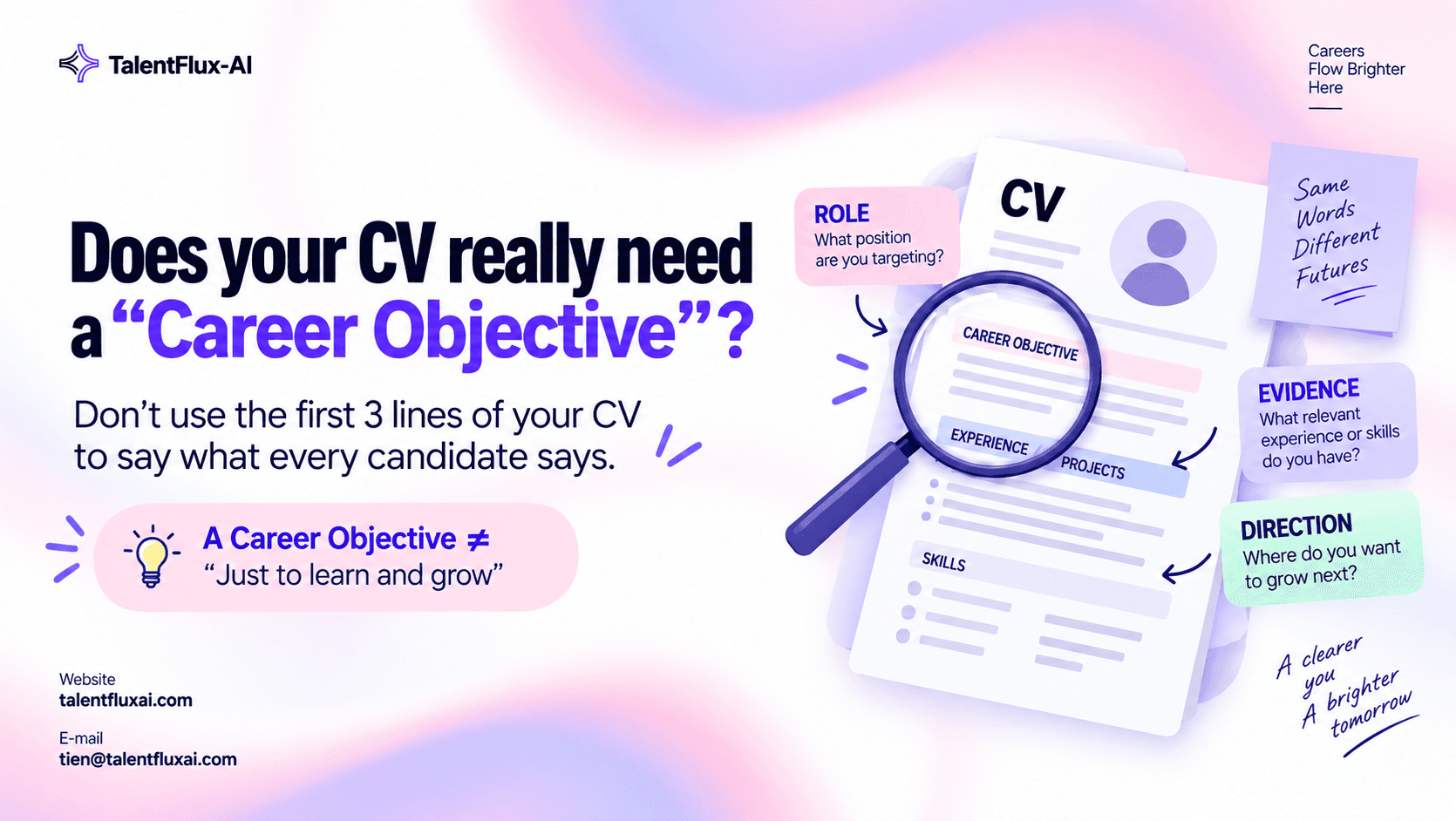
When reading a Career Objective, recruiters need to quickly understand:
What do you want to do? What relevant experience do you have? And in which direction do you want to develop?
If the answer is still “I want to learn and grow,” it may be time to rewrite it.
1. A Career Objective Is Not a “Mini Cover Letter”
A Career Objective doesn't need to tell recruiters:
- How much you want to learn
- How you want to develop yourself
- What opportunities you expect from the company
- How much you want to contribute to the company
These things sound positive.
But almost every candidate can say them.
Instead of:
❌ “I am seeking a dynamic environment where I can learn and develop myself.”
Try:
✅ “Marketing student with experience in social media content and marketing projects, seeking to develop further in Content Marketing.”
With just one sentence, the recruiter already knows:
Who you are → What you have → Where you want to go.
That's what a Career Objective should do.
2. Try the “3 Questions” Before You Write
Don't open Google and search: “Best Career Objective for CV.”
Open your own CV instead.
Then answer these three questions:
01 - Where am I heading?
What kind of role do you want?
- Content Marketing?
- Digital Marketing?
- Brand Marketing?
- Sales?
- HR?
Don't try to write one objective that fits every career path.
02 - What do I already have?
Never had a full-time job? That's okay.
Look again:
- University projects
- Internships
- Part-time jobs
- Volunteering
- Student clubs
- Personal projects
A university project can still show that you've researched, analyzed, created, presented, or worked in a team.
03 - Are the two connected?
This is the most important part.
For example:
**Marketing student
** ↓
**Social media project
** ↓
Content Marketing
Now your career direction starts to make sense.
The recruiter doesn't have to figure out your story.
You've already told it.
3. “I Want to Learn” Isn't Wrong. It's Just Not Enough.
You can still say that you want to learn.
Just don't make it the only thing in your Career Objective.
❌ “I am eager to learn new skills and gain valuable experience.”
The recruiter may ask:
Learn what?
Instead:
✅ “Marketing student with experience in social media content, seeking to further develop skills in Digital Marketing.”
Now the story is clearer.
You're not saying: “I know everything.”
You're saying: “I already have this foundation, and I want to develop further in this direction.”
For students and freshers, that is much clearer.
4. Don't Make Your Career Objective Sound Like a CEO
Some CVs try to sound extremely “professional” by adding as many buzzwords as possible:
- Highly motivated
- Passionate
- Dynamic
- Results-driven
- Innovative
- Proactive
These words aren't necessarily wrong.
But if your Career Objective is made up mostly of buzzwords, the recruiter may still wonder:
What do you actually want to do?
Instead of:
“A highly motivated and passionate individual seeking a dynamic environment…”
Try:
“Marketing student with experience in social media content and campaign projects, seeking to develop further in Content Marketing.”
Specific > fancy.
A simple but specific sentence is often more useful than one that sounds highly professional but doesn't actually say much.
5. “I'm a Student. What Do I Even Have to Write?”
This is probably one of the most common questions among freshers.
But try looking at your CV differently.
Have you ever:
Worked on a university project?
→ You may have researched, analyzed data, or presented findings.
Worked in a student club?
→ You may have created content, designed materials, or coordinated an event.
Had a part-time job?
→ You may have communicated with customers, solved problems, or worked with KPIs.
Worked on a personal project?
→ You may have built a website, social media page, portfolio, or campaign.
Don't turn these experiences into something they're not.
A university project isn't full-time professional experience.
But it can still be evidence of what you can do.
6. Your Career Objective Shouldn't Be the Same for Every Job
Imagine you're applying for:
Content Marketing Intern
You could highlight:
Content creation + Social Media + Campaigns
But if you're applying for:
Brand Marketing Intern
You could focus on:
Marketing projects + Consumer insights + Campaign planning
And for:
Digital Marketing Intern
You could mention:
Digital campaigns + Social Media + SEO
You're still the same person.
You're simply putting the most relevant part of your background into the right context.
That's tailoring.
7. Three Career Objective Formulas You Can Actually Use
🎯 Formula 1 - Student
[Current profile] + [Relevant experience] + [Target direction]
Example:
Marketing student with experience in social media content and university marketing projects, seeking to develop further in Content Marketing.
🎯 Formula 2 - Fresher
Recent [degree/major] graduate with experience in [relevant area], seeking an entry-level opportunity in [target field].
🎯 Formula 3 - Career Switcher
Professional with experience in [previous field] and transferable skills in [relevant skills], seeking to transition into [target field].
You don't need to copy these formulas word for word.
Just remember:
Who am I + What do I have + Where do I want to go?
8. Try the “10-Second Test”
Now open your CV.
Then:
- Read only the Career Objective.
- Don't read Experience.
- Don't read Skills.
- Don't read Education.
Then ask yourself:
“If a recruiter only read this section, would they know what direction I'm applying for?”
If the answer is no → rewrite it.
If the answer is yes, ask:
“Would they know what relevant background I have for that direction?”
If both are clear:
You're on the right track.
9. Signs Your Career Objective Needs a Rewrite 🚩
🚩 **“Seeking a challenging position…”
** → What kind of position?
🚩 **“Passionate about learning…”
** → Learning what?
🚩 **“Contribute to company success…”
** → How?
🚩 **A paragraph full of buzzwords
** → Where's the evidence?
🚩 **Copying the same objective for every CV
** → Is it actually relevant to the role?
🚩 **Making claims you can't prove
** → If the recruiter asks for an example, can you provide one?
Your Career Objective doesn't need to answer everything.
It simply needs to make the recruiter think: “Okay, I understand where this candidate is heading.”
10. Before You Hit “Apply,” Complete These 3 Sentences
**I am…
** → Current profile
**I have…
** → Relevant experience
**I want to…
** → Career direction
If you can connect these three into a short, natural, and specific paragraph:
You already have a strong starting point for your Career Objective.
Stop Writing What Recruiters Have Read 100 Times
Your Career Objective doesn't need to be “impressive.”
It needs to be clear.
You don't need to say: “I want to learn.”
Everyone wants to learn.
You don't need to say: “I want to grow.”
Everyone wants to grow.
Tell the recruiter what they actually need to know:
- Who you are.
- What you've done.
- Where you're going.
Because a Career Objective isn't there to explain why you need a job.
It helps the recruiter understand why the rest of your CV is worth reading.
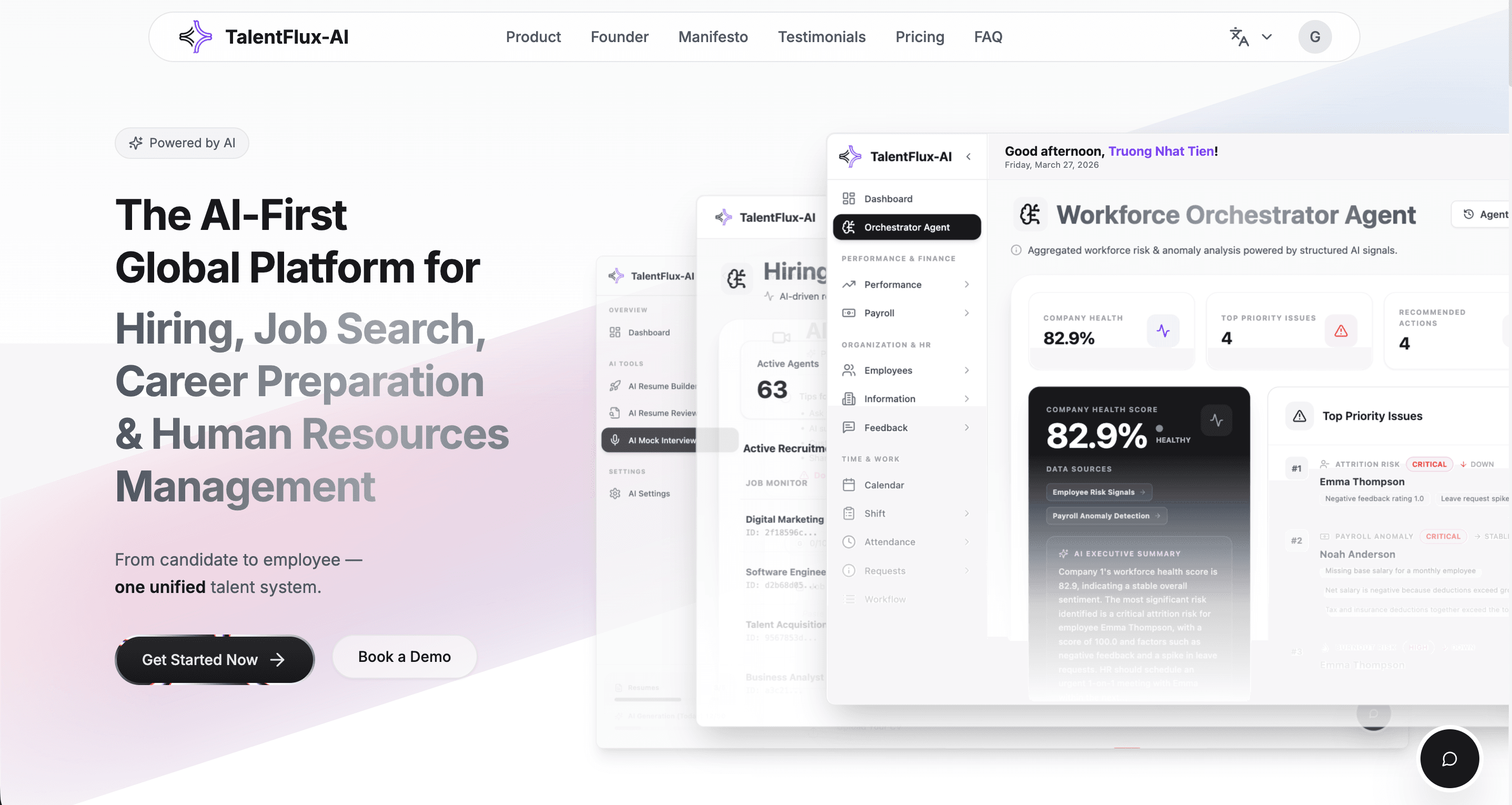
🚀 TalentFlux-AI can help you build and optimize your CV for the role you are applying for, so you can review how your experience and relevant information are presented.
👉 Create your CV with TalentFlux-AI: talentfluxai.com