A new employee starts on Monday morning. By 10 a.m., their laptop still isn't set up. By noon, nobody has explained what they need to do this week. By the end of the first month, they are browsing job listings again. If your business has seen this happen, the problem usually isn't hiring. It is employee onboarding.
Employee onboarding is the process of helping a new hire understand the job, the people and the culture, and then start producing results. Done well, it keeps the people you worked hard to hire. Done poorly, most of your recruitment spend goes to waste.
This article helps HR teams and line managers build an onboarding process using a 30-60-90 day framework: what to prepare before day one, goals for each stage, who does what, common mistakes and how to measure results. You will find a checklist you can use right away.
1. What is employee onboarding?
Onboarding is a planned series of activities that starts when a candidate accepts the offer and continues until they can work independently, usually during their first three months.
Many businesses confuse onboarding with a first-day orientation. The two are quite different:
| Criteria | Orientation | Onboarding |
|---|---|---|
| Duration | A few hours to 1-2 days | Usually 30-90 days, sometimes longer |
| Content | Rules, paperwork, company introduction | Job goals, skills, relationships, culture, reviews |
| Owner | Mainly HR | HR, line manager, buddy, the whole team |
| Goal | The new hire knows the rules | The new hire can do the job and wants to stay |
Orientation is only a small part of onboarding. If your process ends after day one, new hires are left to guess the rest.
2. Why onboarding decides whether new hires stay or leave
A few figures worth noting:
-
In a Futurestep (Korn Ferry) survey of 1,817 business executives, reported by SHRM (2017), 90% said new-hire retention is an issue for their organization, and 52% said 10-25% of new hires leave within the first six months. 98% agreed that onboarding is a key factor in retention.
-
In another survey of 350 HR leaders in the US by Kronos and the Human Capital Institute, reported by SHRM (2018), 76% said their workplace does not onboard new hires effectively, and 24% said their organization has no onboarding program at all.
-
Gallup's State of the Global Workplace 2026 report found that only 20% of employees worldwide are engaged at work (2025 data). Southeast Asia stands at 25% (a multi-year aggregate). This is general engagement rather than onboarding, but it suggests many new hires join workplaces where engagement is already low, which makes the first weeks matter even more.
These surveys were conducted outside Vietnam and several years ago, so treat them as signals rather than benchmarks. The logic still applies to Vietnamese businesses: the first weeks are when new hires test the promises made during recruitment. If the real job is far from the description, or nobody guides them, they start considering other options very early.
Vietnam has one more milestone to keep in mind: the probation period. Under Article 25 of the 2019 Labor Code, probation may not exceed 180 days for enterprise managers, 60 days for jobs requiring professional or technical qualifications at college level or higher, 30 days for jobs requiring intermediate vocational qualifications, technical workers or professional staff, and 6 working days for other jobs. A worker can be placed on probation only once per job.
3. Preparing before day one (preboarding)
First impressions form before the first day. Preboarding starts when the candidate accepts the offer. In Vietnam, candidates often serve a 30-45 day notice period, a time when drop-outs are common, so stay in touch. About 3-7 days before the start date, HR and the manager should complete the following:
Preboarding checklist
-
Send a welcome email: arrival time, address, who will meet them, dress code, documents to bring.
-
Prepare the laptop, email account, work software and necessary access.
-
Choose a buddy in the team and let that person know in advance.
-
Schedule the first week: meeting with the manager, team introduction, training sessions.
-
Prepare documents: job description, team chart, key processes, contact list.
-
Tell the whole team who is joining and what their role is.
Hypothetical example: a software company of about 50 people in Hanoi usually spends the first half-day setting up a new hire's laptop. Simply moving this task to the day before lets the new hire start learning about their project on the very first morning.
4. A 30-60-90 day onboarding plan
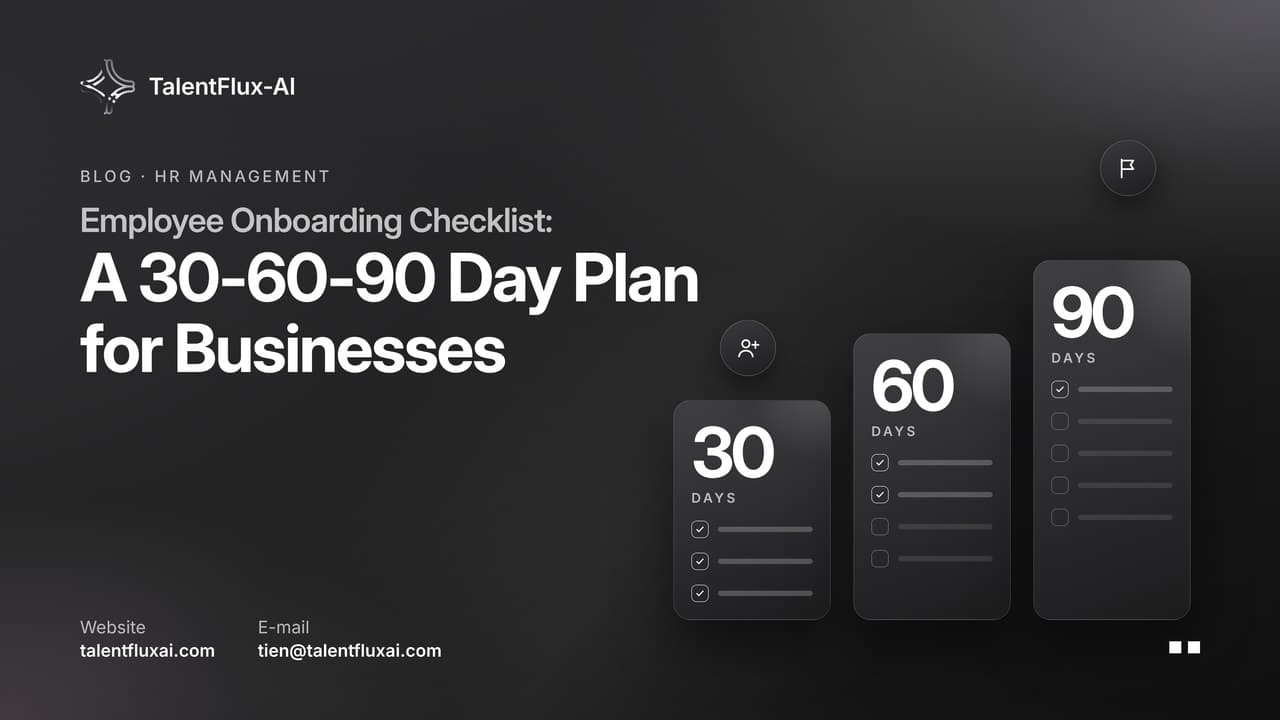
The 30-60-90 day framework splits a new hire's journey into three stages, each with clear goals and checkpoints.
| Stage | Main goal | New hire's tasks | Manager's tasks |
|---|---|---|---|
| Days 1-30: Learn | Understand the job, people and processes | Read documents, join meetings, do small guided tasks | Set clear expectations, weekly 1:1s |
| Days 31-60: Contribute | Handle part of the work independently | Take on own tasks, suggest small improvements | Increase responsibilities, give specific feedback |
| Days 61-90: Own | Work independently with measurable results | Own an area of work, set goals for next quarter | 90-day onboarding review, agree on next-quarter goals |
If the role has a 30-day probation, compress the plan: weeks 1-2 learn, weeks 3-4 contribute, with the probation review at days 25-30. The ‘Own’ stage then follows the formal contract.
Days 1-30: Learn
The focus is helping the new hire understand what their job is, who they work with and how things are done. In the first week, the manager should hold a 1:1 to answer three questions: what the new hire needs to achieve in 30 days, which channel to use for updates, and who to ask when they get stuck.
Assign a small task that can be finished in the first week. An early result, however small, builds far more confidence than a week of reading documents.
Days 31-60: Contribute
The new hire starts taking on their own tasks, with a buddy still available for questions. This is also a good time to ask them: what in the current process doesn't make sense? New hires often spot issues that long-time staff have stopped noticing.
For roles with a 60-day probation, the end of this stage is the probation review. If goals were written down in the first week, the review will be based on results rather than impressions.
Days 61-90: Own
The new hire owns an area of work and has their own performance metrics. The manager agrees with them on goals for the next quarter, using KPIs or OKRs. If you are unsure which to use, our article on the difference between KPI and OKR explains both in detail.
5. The roles of HR, line managers and buddies
Onboarding often fails because everyone thinks it is someone else's job. Clear roles prevent this:
-
HR: designs the overall process, handles paperwork, contracts, insurance and system accounts, and tracks onboarding progress for every new hire.
-
Line manager: sets expectations, assigns work, holds regular 1:1s and conducts the probation review. This person has the biggest influence on whether a new hire stays.
-
Buddy: answers the "small questions people hesitate to ask the boss", such as where to have lunch, how to use internal tools and who handles what.
In the same 2017 survey reported by SHRM, 98% of executives agreed that mentoring would improve retention, yet only 23% had a mentoring program for all employees.
The 2018 survey also found that the most common reason onboarding gets neglected is that managers lack time (57%). So put 1:1s with new hires on the calendar from the start, instead of leaving them for "when there is time".
6. Common onboarding mistakes in small and medium businesses
- Day one only, no week two. The orientation is thorough, then the new hire is left alone.
- Too many documents at once. The new hire reads 200 pages in the first week but remembers little because none of it is tied to real work.
- Goals are never written down. Expectations live only in the manager's head, and by the end of probation both sides understand them differently.
- The real job differs from what was described during hiring. This is the fastest way to lose a new hire's trust. The job description and interview should match the work they will actually do.
- Data is scattered. Candidate profiles are in one place, contracts in email, attendance in Excel and goals in chat messages. HR re-enters data, and new hires fill in the same information several times.
- Nobody asks new hires for feedback. No one knows whether onboarding is working until someone quits.
7. How to measure and digitize your onboarding process
Metrics to track
-
New-hire turnover within 90 days and 6 months.
-
Probation pass rate.
-
Time for a new hire to complete their first independent task.
-
New-hire satisfaction at 30, 60 and 90 days.
Short survey questions for new hires
-
Does the actual job match the description during recruitment?
-
Do you know clearly what you need to achieve next month?
-
When you face a problem, do you know who to ask?
-
What should be done differently in the first few weeks?
Digitize so data flows seamlessly
Onboarding is the bridge between recruitment and HR management. When the two run on separate systems, candidate information has to be re-entered from scratch when they become employees. Our article on employee lifecycle management explains in more depth why this whole journey is best managed on one system.
A practical step: let new hires view their schedules and payslips and request leave through an app from their first week, instead of asking HR for each item. See also our article on what Employee Self-Service (ESS) is.
FAQ
How long should employee onboarding last? 30-90 days is common. For complex or managerial roles, it may last six months. In Vietnam, align review milestones with the probation period for each role.
How can a small business without a dedicated HR team handle onboarding? Start with three things: a preboarding checklist, a weekly 1:1 between the manager and the new hire, and a buddy. You don't need complex software to do these three things.
What is the difference between onboarding and training? Training focuses on job skills. Onboarding is broader: it includes training, job goals, team relationships, culture and administrative procedures.
Conclusion
Employee onboarding doesn't have to be expensive, but it does need a plan: preparation before day one, clear goals for each 30-60-90 day milestone, defined roles for managers and buddies, and a few metrics to know how well the process is working. Start with the preboarding checklist in this article for your next new hire.
If you want data from recruitment to flow straight into HR management, TalentFlux-AI connects both on one platform: the Workforce Agent supports task assignment, shift scheduling, attendance, KPI tracking and payroll as soon as a candidate becomes an employee. Try it or book a demo at talentfluxai.com.