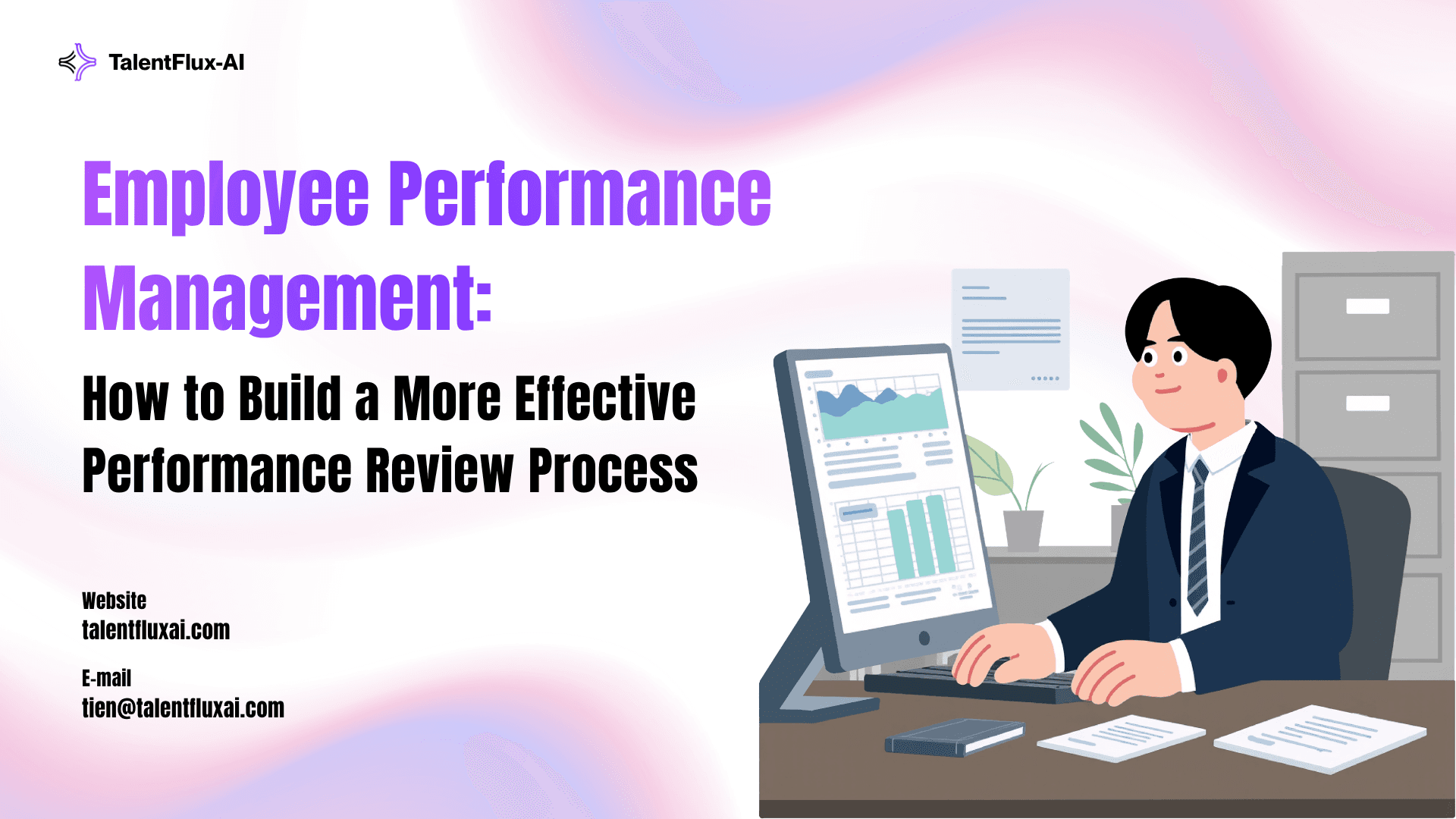
Employee Performance Management: How to Build a More Effective Performance Review Process
Performance reviews are often treated as a once-a-year HR task.
But effective employee performance management is broader than an annual review. It involves setting expectations, tracking progress, providing feedback, identifying development needs, and connecting individual performance with business goals.
In 2026, performance management and employee development remain important areas for HR teams. McKinsey's 2026 HR Monitor notes that organizations are placing renewed emphasis on measurable performance and systematic capability building, while feedback and training remain uneven across organizations.
So what does a more effective performance management process look like?
1. What Is Employee Performance Management?
Employee performance management is the ongoing process of helping employees understand expectations, monitor their progress, receive feedback, and develop the capabilities needed for their roles.
It can include:
- Goal setting
- Performance tracking
- Regular feedback
- Performance reviews
- Skill development
- Development planning
- Recognition and improvement actions
The goal is not simply to assign a rating.
It is to create a clearer connection between:
Expectations → Performance → Feedback → Development
2. Performance Management vs. Performance Review
These terms are often used interchangeably, but they are not exactly the same.
Performance management
An ongoing process that happens throughout the employee lifecycle.
Performance review
A specific evaluation point within that process.
For example:
Goal setting → Monthly check-ins → Feedback → Mid-year review → Development plan → Annual review
A company can have formal reviews without having an effective performance management process.
3. Start With Clear Expectations
Employees cannot be evaluated consistently if they do not know what success looks like.
Before measuring performance, managers should define:
- Key responsibilities
- Expected outcomes
- Relevant KPIs
- Role-specific competencies
- Quality standards
- Development expectations
Instead of:
“Improve your communication skills.”
Use something more observable:
“Provide clear project updates and communicate key risks before agreed deadlines.”
The second version gives both the employee and manager something more concrete to discuss.
4. Connect Goals to the Role
Not every employee should be measured using the same goals.
A sales employee, designer, recruiter, and software engineer may contribute differently to the organization.
Performance criteria should therefore reflect:
Business goals + Role responsibilities + Relevant capabilities
This helps prevent performance management from becoming a generic checklist.
5. Make Feedback an Ongoing Process
Waiting until an annual review to discuss performance can make feedback less useful.
Regular check-ins allow managers to:
- Recognize progress
- Address problems earlier
- Adjust priorities
- Discuss obstacles
- Identify development needs
McKinsey's 2026 research found that feedback cycles remain infrequent in many organizations, with more than half of employees reporting that they receive feedback only once a year or not at all.
This highlights why performance management should not depend entirely on one annual conversation.
6. Evaluate Evidence, Not Just Impressions
Performance reviews can become subjective when managers rely heavily on general impressions.
Instead of:
“They seem more proactive.”
Document evidence such as:
- Completed projects
- Achieved targets
- Customer feedback
- Quality improvements
- Problem-solving examples
- Collaboration outcomes
The question becomes:
What happened, and what evidence supports the evaluation?
7. Use Consistent Evaluation Criteria
Consistency does not mean every employee must have identical goals.
It means the organization should have a clear framework for evaluating performance.
For example:
| Area | What to evaluate |
|---|---|
| Results | Achievement of agreed goals |
| Quality | Accuracy and quality of work |
| Collaboration | Ability to work effectively with others |
| Problem-solving | Handling challenges and finding solutions |
| Development | Progress in relevant skills |
Clear criteria can make performance discussions easier to structure and document.
8. Turn Reviews Into Development Plans
A performance review should not end with a rating.
It can also answer:
- What is the employee doing well?
- What needs improvement?
- What skills should they develop?
- What support do they need?
- What should they work toward next?
This turns performance management into a development process rather than simply an evaluation process.
9. Use Data Without Losing Human Context
HR technology can help organizations organize performance information, track goals, and make employee data easier to access.
But data should support—not completely replace—managerial judgment.
Performance information should be interpreted in context, including:
- Role responsibilities
- Available resources
- Project difficulty
- Changing priorities
- Team dependencies
A number alone does not always explain performance.
10. Why HR Technology Matters
As organizations manage more employee information, performance data can become scattered across spreadsheets, documents, HR systems, and separate communication tools.
A centralized HR platform can help bring together:
- Employee information
- Attendance
- Performance data
- Goals
- Reviews
- Development information
This can make it easier for HR and managers to access relevant information when making people-related decisions.
11. A Simple Performance Management Framework
A practical process can look like:
**1. Define expectations
** ↓
**2. Set measurable goals
** ↓
**3. Track progress
** ↓
**4. Provide regular feedback
** ↓
**5. Review performance
** ↓
**6. Identify development needs
** ↓
**7. Create an action plan
** ↓
8. Follow up
The important part is that the process continues after the review.
12. Performance Management Checklist for HR Teams
Before reviewing your process, ask:
Goals
- Are expectations clearly defined?
- Are goals relevant to each role?
Tracking
- Is performance information documented?
- Can managers access relevant data?
Feedback
- Do employees receive feedback regularly?
- Can employees discuss challenges and development needs?
Evaluation
- Are evaluation criteria clear?
- Are decisions supported by evidence?
Development
- Does every review lead to meaningful next steps?
- Are development needs followed up?
13. Final Takeaway
Effective employee performance management is not simply about giving employees a score.
It is about creating a continuous process where employees understand:
What is expected → How they are performing → Where they can improve → What comes next
For HR teams, the goal is to make performance information clearer, more consistent, and more useful for both employees and managers.
Build a clearer HR management process
TalentFlux-AI brings HR management capabilities into a broader talent ecosystem, helping organizations manage employee and talent information across the workforce lifecycle.
👉 Explore TalentFlux-AI: talentfluxai.com