What Is CV Screening? 7 Effective Criteria for Evaluating Job Applications
1. What Is CV Screening?
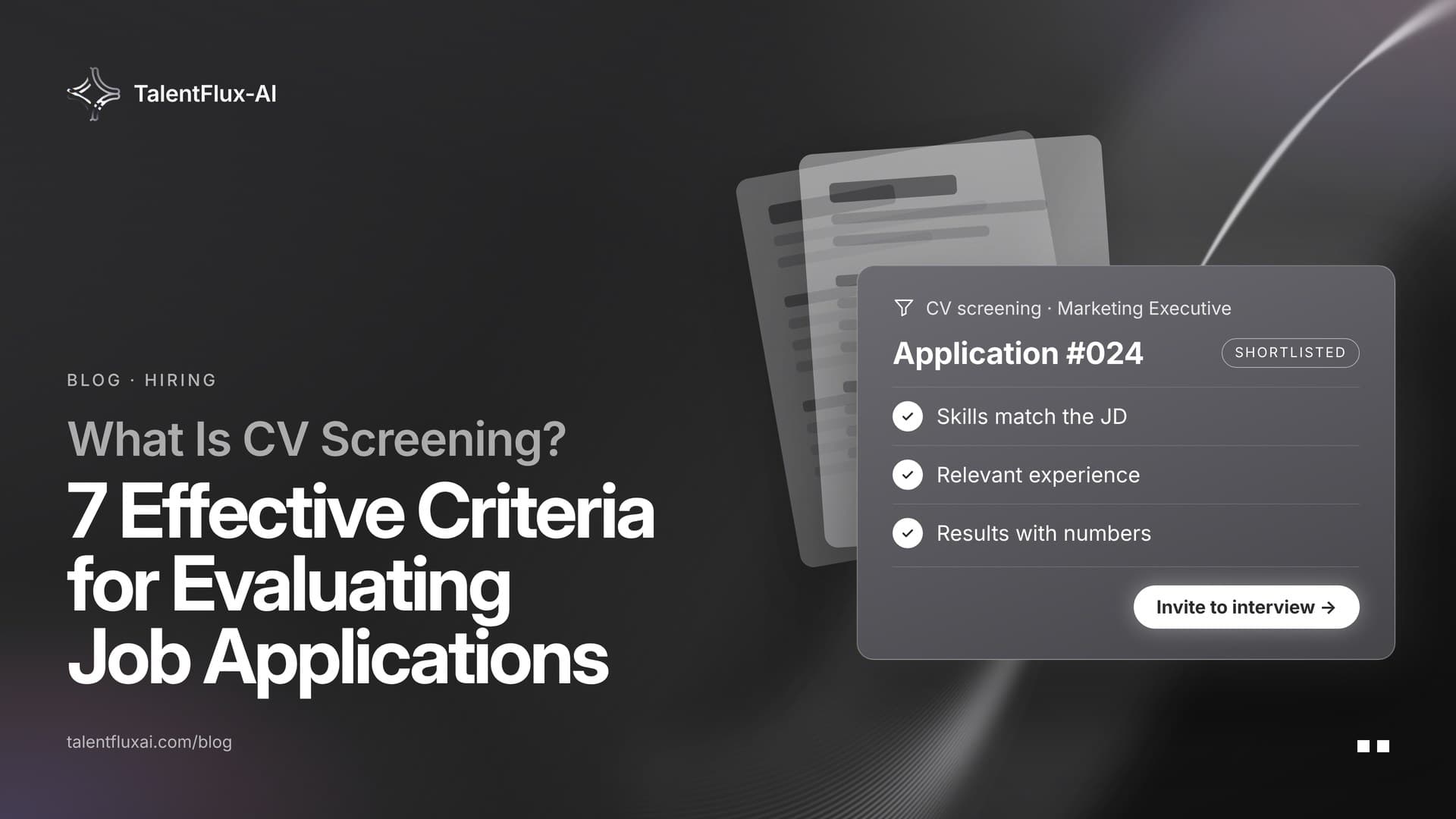
CV screening is the process of reviewing, analyzing, and evaluating job applications to determine how well candidates match the requirements of an open position.
Through this process, recruiters compare the information provided in candidates' CVs with the job description (JD) to identify suitable applicants for the next stages of recruitment.
CV screening typically involves three main activities:
-
Resume Review: Checking candidates' personal information, education, work experience, and skills.
-
Candidate Evaluation: Assessing candidates' suitability based on predefined recruitment criteria.
-
Shortlisting: Creating a list of qualified candidates to proceed to interviews or further assessments.
CV screening is not simply about finding candidates with the most years of experience. The goal is to identify individuals whose qualifications, skills, and potential align with the actual requirements of the position.
2. Why Is CV Screening Important in Recruitment?
When a company receives hundreds of applications for a single position, reviewing each CV without a structured process can consume significant time and cause recruiters to overlook promising candidates.
An effective CV screening process offers several benefits:
Saves Recruitment Time
Recruiters can quickly categorize applications based on predefined criteria, reducing the time spent reviewing CVs that do not meet essential requirements.
Improves Candidate Quality
Evaluating candidates based on their skills, experience, and alignment with the job description helps companies focus on applicants who are capable of performing the role.
Promotes Objective Hiring Decisions
Consistent evaluation criteria help minimize decisions based on personal impressions or individual preferences.
Streamlines the Recruitment Process
When applications are properly categorized and tracked, HR teams can manage candidate lists more efficiently, coordinate subsequent recruitment stages, and collaborate with hiring managers.
3. 7 Effective CV Screening Criteria for HR Professionals
To evaluate applications consistently, HR professionals should develop screening criteria based on the actual requirements of each position rather than applying the same standards to every candidate.
3.1. Alignment with Job Requirements
This is one of the most important criteria in CV screening. Recruiters should compare candidates' profiles with the requirements outlined in the job description, including responsibilities, skills, and essential qualifications.
Requirements can be divided into two categories:
-
Must-have: Essential qualifications and skills that candidates are expected to possess.
-
Nice-to-have: Additional skills or experience that may give candidates a competitive advantage.
This distinction helps recruiters identify which qualifications are genuinely necessary and avoid rejecting promising applicants simply because they lack a non-essential skill.
3.2. Educational Background and Professional Certifications
Educational qualifications and professional certifications provide additional insights into a candidate's knowledge and professional foundation.
Depending on the position, recruiters may consider:
-
Relevant degrees and academic backgrounds.
-
Professional or industry-specific certifications.
-
Additional training courses.
-
The relevance of academic knowledge to the job requirements.
However, educational qualifications should not be the sole factor determining a candidate's suitability, particularly for positions that prioritize practical experience and professional skills.
3.3. Relevant Work Experience
When reviewing work experience, recruiters should look beyond the total number of years a candidate has worked. More importantly, they should assess how relevant previous experience is to the position.
Key aspects to consider include:
-
Previous job titles and industries.
-
Responsibilities and tasks in previous roles.
-
Relevance to the current job description.
-
Experience handling similar projects or workplace challenges.
For example, a candidate with two years of direct Marketing experience may be more suitable for a Marketing position than someone with five years of experience primarily in an unrelated field.
3.4. Technical and Soft Skills
Skills help recruiters evaluate a candidate's ability to perform the job effectively.
They can generally be divided into two categories:
-
Hard Skills: Technical or professional abilities such as data analysis, graphic design, programming, project management, and industry-specific software proficiency.
-
Soft Skills: Communication, teamwork, problem-solving, critical thinking, and time management.
Recruiters should look for evidence of these skills in candidates' projects, work experience, and achievements rather than relying solely on self-reported skill lists.
3.5. Professional Achievements and Work Results
Achievements provide insights into the value candidates have delivered in previous roles.
CVs that demonstrate measurable results often offer more useful information than those containing only general descriptions of job responsibilities.
For example:
-
Increased website traffic by 25% through SEO campaigns.
-
Managed a project with a budget of VND 100 million.
-
Improved conversion rates by 15% through advertising campaign optimization.
These figures should be evaluated within the context of each candidate's actual responsibilities and verified during subsequent recruitment stages when necessary.
3.6. Career Progression
A candidate's employment history can reveal their career direction, professional development, and ability to take on new responsibilities.
Recruiters should pay attention to:
-
Changes in job titles and responsibilities over time.
-
New skills acquired throughout their career.
-
Professional growth and development.
-
Reasons for changing roles or industries, when information is available.
However, recruiters should not automatically reject candidates simply because they have changed jobs frequently or experienced career gaps. These circumstances should be evaluated within their broader professional context.
3.7. CV Completeness and Clarity
A well-organized CV makes it easier for recruiters to access and evaluate relevant information.
When reviewing the presentation of an application, recruiters should check:
-
Are the contact details complete and accurate?
-
Is work experience presented in a logical order?
-
Is the information clear and easy to follow?
-
Are there spelling mistakes or inconsistencies?
A simple CV design does not necessarily indicate a lack of professional ability. Recruiters should prioritize content and job relevance rather than judging candidates solely by visual presentation.
4. 5 Steps to an Effective CV Screening Process
To minimize errors and save time, companies can implement a structured screening process through the following steps:
Step 1: Analyze the Job Requirements
HR professionals should understand the responsibilities, qualifications, and competencies required for the position. Consulting with hiring managers or relevant departments can help establish more accurate recruitment criteria.
Step 2: Develop Evaluation Criteria
Establish specific screening criteria and distinguish between essential and preferred qualifications. If multiple recruiters are involved, they should agree on a consistent evaluation approach before reviewing applications.
Step 3: Review and Categorize CVs
Evaluate applications based on the predefined criteria. Candidates can be divided into three groups:
-
Qualified: Meets the main requirements of the position.
-
Potential: Shows promise but requires further clarification or assessment.
-
Not Qualified: Does not meet the essential requirements.
Step 4: Evaluate Candidates and Create a Shortlist
Score candidates based on their suitability, then select the most promising applications for interviews or further assessments.
Step 5: Update Candidate Statuses
Record screening results and update each candidate's recruitment status. This helps HR teams monitor hiring progress, avoid overlooking applications, and coordinate more effectively with other departments.
5. Sample CV Screening Scorecard for HR
A standardized scorecard helps recruiters compare candidates using the same evaluation criteria.
Below is an example of a CV evaluation scorecard for a Marketing Executive position:
| Evaluation Criteria | Weight |
|---|---|
| Alignment with job requirements | 25% |
| Relevant work experience | 20% |
| Technical skills | 20% |
| Achievements and results | 15% |
| Education and certifications | 10% |
| Soft skills | 10% |
| Total | 100% |
HR professionals can score each criterion on a scale of 1 to 10 and calculate the final score based on the assigned weight.
Scoring formula:
Total Score = (Criterion 1 Score × Weight 1) + ... + (Criterion 6 Score × Weight 6).
For example, if a candidate receives 8/10 for alignment with job requirements, the weighted score for this criterion is 8 × 25% = 2 points.
The weighting should be adjusted according to the requirements of each position. A scorecard is a decision-support tool, not a substitute for verifying candidate information or assessing their abilities in subsequent recruitment stages.
6. Using ATS and AI in CV Screening
As application volumes increase, manually reviewing every CV can create significant pressure on HR departments. This is why many companies are beginning to adopt technology to support their recruitment processes.
What Is an ATS?
An Applicant Tracking System (ATS) is a software platform that helps companies collect, store, track, and manage candidate applications throughout the recruitment process.
Depending on the platform, an ATS may support:
-
Centralizing candidate applications in one system.
-
Tracking candidate statuses and recruitment progress.
-
Searching for information within applications.
-
Categorizing candidates based on predefined criteria.
How Can AI Support CV Screening?
AI-powered tools can help HR professionals process candidate information more efficiently through capabilities such as:
-
Extracting skills and work experience from CVs.
-
Comparing candidate information with job requirements.
-
Summarizing application content.
-
Supporting candidate classification and organization.
However, companies should not rely entirely on automated results. Systems may overlook qualified candidates who use different wording from the keywords in a job description or produce unfair outcomes when the underlying data and evaluation criteria contain bias.
Therefore, HR professionals should review automated results, consider the context, and remain responsible for final recruitment decisions.
7. Common CV Screening Mistakes HR Should Avoid
Even with a structured process, recruiters may still make mistakes that affect recruitment quality.
Focusing Only on Keywords
Candidates may use different terms to describe the same skills or experience. Searching for exact keywords alone can cause recruiters to overlook suitable applicants.
Overvaluing Educational Qualifications
Academic credentials are useful references, but they do not always reflect practical abilities. Recruiters should also consider experience, skills, and professional achievements.
Rejecting Candidates Because of Career Gaps
Career gaps can occur for various reasons. Recruiters should seek additional context rather than automatically treating them as negative indicators.
Making Decisions Based on Irrelevant Personal Characteristics
Age, gender, marital status, and physical appearance should not be used as evaluation criteria when they are unrelated to job requirements. Recruitment decisions should focus on relevant professional qualifications and competencies.
Using Inconsistent Evaluation Criteria
When recruiters assess CVs differently, candidate selection can become inconsistent. Companies should establish shared evaluation criteria and agree on a scoring approach before starting the screening process.
8. Frequently Asked Questions About CV Screening
Is CV Screening different from Resume Screening?
Both terms generally refer to the process of reviewing and evaluating job applications. CV is commonly used in many countries, while Resume typically refers to a shorter summary of professional experience and skills, particularly in the United States.
How much time should HR spend screening each CV?
The time required depends on the complexity of the position, the number of applications, and the level of detail involved in the evaluation process. Rather than setting a fixed time limit, HR teams should establish clear criteria to balance efficiency and assessment quality.
Can an ATS automatically reject unsuitable CVs?
Some ATS platforms offer automated filtering based on predefined criteria or screening questions. However, not all ATS platforms automatically reject candidates. Their functionality depends on the system's features and configuration.
Should companies use AI for CV screening?
AI can be used to support information processing and analysis, particularly when companies receive large volumes of applications. However, HR professionals should still review the results and make decisions based on objective recruitment criteria.
9. Conclusion
CV screening is a critical stage in recruitment that directly influences the quality of a company's candidate pool. Establishing clear evaluation criteria, assessing applicants consistently, and adopting appropriate technology can help HR teams save time, reduce errors, and identify more suitable candidates.
Beyond recruitment, companies also need an effective work management system to coordinate teams and monitor progress after new employees join the organization.
TalentFlux-AI supports businesses in managing teams, tasks, and progress centrally on one platform, helping streamline daily operations and improve internal collaboration.
References
- Society for Human Resource Management (SHRM) – How to Screen Resumes Efficiently: A Beginner's Guide.
- Chartered Institute of Personnel and Development (CIPD) – Selection Methods.
- National Institute of Standards and Technology (NIST) – Guidance on Writing a Hiring Rubric.