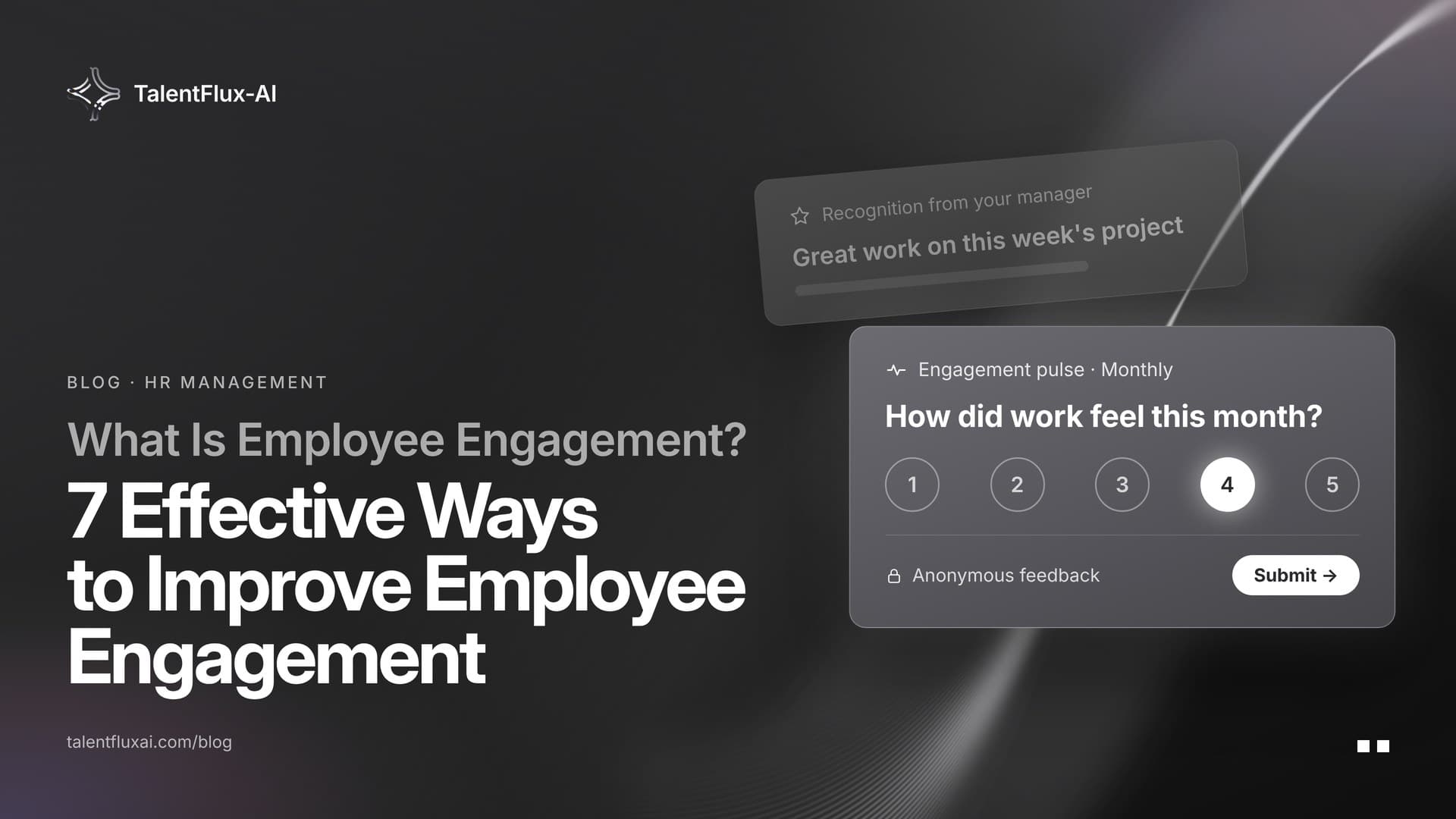
What Is Employee Engagement? 7 Effective Ways to Improve Employee Engagement
In today's workplace, attracting talented employees is only part of the challenge. Retaining them and maintaining their motivation can be even more difficult. Having skilled employees does not necessarily mean they will remain proactive, committed, or willing to stay with an organization if they lack a sense of purpose and connection at work.
This is why Employee Engagement has become an increasingly important part of modern human resource management. Beyond creating a comfortable workplace, organizations need to build an environment where employees feel valued, have opportunities to grow, and genuinely want to contribute.
So, what is employee engagement? Why does it matter, and how can businesses improve it? Let's explore seven practical strategies, along with effective ways to measure employee engagement.
1. What Is Employee Engagement?
Employee Engagement refers to the level of emotional, cognitive, and behavioral connection employees have with their work and organization.
Highly engaged employees do more than simply complete assigned tasks. They take initiative, collaborate with colleagues, seek opportunities to improve their performance, and contribute to the organization's overall goals.
According to the Utrecht Work Engagement model, work engagement consists of three key dimensions:
-
Vigour: Employees demonstrate high energy, mental resilience, and a willingness to put effort into their work, even when facing challenges.
-
Dedication: Employees find their work meaningful, feel enthusiastic about their responsibilities, and take pride in what they do.
-
Absorption: Employees are deeply focused and immersed in their work, often finding it difficult to disengage from their tasks.
It is also important to distinguish Employee Engagement from Employee Satisfaction. An employee may be satisfied with their salary, benefits, or working conditions without necessarily feeling emotionally connected to the organization or motivated to contribute beyond their basic responsibilities.
Therefore, businesses should look beyond employee satisfaction and pay attention to motivation, commitment, and employees' willingness to grow with the organization.
2. Why Is Employee Engagement Important?
Employee Engagement affects not only individual employee experiences but also the overall performance of an organization.
According to Gallup's 2024 report, The Relationship Between Engagement at Work and Organizational Outcomes, which analyzed 736 studies across 347 organizations and more than 3.35 million employees, employee engagement was associated with 11 different business outcomes.
These findings highlight that employee engagement is not simply an internal HR initiative. It is also an important part of an organization's broader business strategy.
2.1. Improving Employee Performance and Productivity
Engaged employees tend to take greater initiative, approach challenges proactively, and demonstrate stronger accountability for their results.
When employees understand organizational goals and recognize the value of their contributions, they are more likely to invest effort in their responsibilities. This can improve team coordination, work quality, and overall productivity.
2.2. Increasing Employee Retention
Employees may leave an organization when they feel undervalued, lack career development opportunities, or no longer feel connected to their workplace.
A strong employee engagement strategy helps businesses identify these concerns earlier and improve the overall employee experience. This can contribute to stronger employee relationships and long-term retention.
2.3. Building a Positive Workplace Culture
Employee engagement encourages trust, collaboration, and mutual support among team members.
When employees feel that they belong to the organization, they are more likely to build meaningful working relationships and contribute to a positive workplace culture.
2.4. Encouraging Innovation and Adaptability
Employees who feel heard and empowered are more willing to share ideas, suggest improvements, and participate in problem-solving.
This creates an environment where innovation is encouraged and businesses can respond more effectively to organizational and market changes.
3. 7 Effective Ways to Improve Employee Engagement
Improving employee engagement does not always require expensive programs or large-scale initiatives. Small but consistent improvements in communication, management practices, and employee recognition can make a meaningful difference.
3.1. Build an Open Communication Environment
Communication is the foundation of trust within an organization. When employees receive limited information or have no opportunities to express their opinions, they may feel disconnected from company decisions and goals.
Businesses can improve internal communication by:
-
Organizing regular one-on-one meetings between employees and managers.
-
Providing updates on company goals, performance, and business direction.
-
Creating channels for employee feedback and suggestions.
-
Encouraging employees to raise questions and discuss challenges openly.
More importantly, organizations should respond to employee feedback and demonstrate that their opinions are genuinely considered.
3.2. Recognize and Reward Employee Contributions
Feeling appreciated is an important part of maintaining employee motivation.
Recognition does not always have to involve significant financial rewards. A specific thank-you from a manager, public acknowledgment during a team meeting, or an opportunity to participate in an important project can also motivate employees.
Businesses can introduce initiatives such as:
-
Employee of the Month or Employee of the Quarter programs.
-
Performance-based bonuses and incentives.
-
Recognition for ideas that improve business processes.
-
Rewards for both individual and team achievements.
However, recognition should be timely, transparent, and fair. Unclear reward criteria can create perceptions of favoritism rather than strengthen employee engagement.
3.3. Provide Learning and Career Development Opportunities
Employees are more likely to stay motivated when they can see opportunities for professional growth within their organization.
On the other hand, continuously performing repetitive tasks without a clear career path may gradually reduce their enthusiasm and motivation.
To address this, businesses should:
-
Establish clear career development paths for different positions.
-
Provide professional training and soft skills development.
-
Introduce mentoring programs between employees and managers.
-
Offer opportunities to work on new projects or explore different roles.
-
Conduct regular career development discussions.
Managers should also take time to understand employees' individual strengths, interests, and career aspirations. This allows development plans to better reflect employees' actual needs.
3.4. Create a Positive Workplace Culture
Workplace culture influences how employees communicate, collaborate, and perceive their organization.
A positive workplace is not built solely through team-building activities or company events. It is also reflected in how employees are treated and supported in their everyday work.
Organizations should focus on:
-
Respecting different perspectives and working styles.
-
Encouraging collaboration across departments.
-
Promoting transparency and accountability.
-
Creating a psychologically safe environment where employees can express their opinions.
-
Ensuring that leadership behavior reflects the organization's stated values.
Team-building activities, internal events, and social gatherings can help strengthen relationships among colleagues. However, they are most effective when supported by a genuinely respectful and positive working environment.
3.5. Empower Employees and Encourage Autonomy
Excessive supervision and micromanagement can make employees feel that they are not trusted or given enough opportunities to demonstrate their abilities.
Instead of controlling every step, managers should establish clear objectives, define responsibilities, and allow employees to take ownership of their work.
Practical approaches include:
-
Encouraging employees to propose their own solutions.
-
Delegating responsibilities based on individual capabilities.
-
Allowing employees to manage their work schedules and progress.
-
Creating opportunities to test new ideas.
-
Evaluating employees based on outcomes rather than simply monitoring working hours.
Empowerment does not mean abandoning management responsibilities. Managers still need to monitor progress, provide support, and ensure that employees understand their roles and expectations.
3.6. Support Employee Well-Being and Work-Life Balance
Long-term stress, excessive workloads, and insufficient rest can gradually reduce employee motivation and engagement.
Businesses should therefore consider physical and mental well-being as an essential part of their employee engagement strategies.
Some practical initiatives include:
-
Distributing workloads according to employees' capacity.
-
Reducing unnecessary overtime.
-
Offering flexible leave policies where possible.
-
Encouraging employees to take breaks after demanding periods.
-
Organizing health and wellness initiatives.
Organizations should also address the underlying causes of excessive workloads instead of relying solely on recreational activities to temporarily improve employee morale.
3.7. Use Technology to Improve Workforce Management
As organizations grow, managing employee information, assigning responsibilities, and tracking progress through manual processes can become increasingly complicated.
Technology can help centralize information, improve communication, and reduce unnecessary administrative tasks.
Workforce management platforms can support businesses by enabling them to:
-
Assign and track tasks more clearly.
-
Monitor project and team progress.
-
Manage team information and activities.
-
Improve coordination across departments.
-
Increase transparency in daily operations.
Technology cannot replace meaningful human relationships or genuine management support. However, when implemented effectively, it can help businesses create a more organized and productive working environment.
4. How to Measure Employee Engagement
To determine whether employee engagement initiatives are effective, businesses need appropriate measurement methods.
Rather than relying solely on management assumptions, HR teams should combine employee feedback with relevant workforce metrics to gain a more comprehensive understanding.
4.1. Employee Engagement Surveys
Employee engagement surveys are commonly used to understand employees' perceptions of their workplace, management, career opportunities, and connection to the organization.
Sample survey statements include:
-
I clearly understand the goals and expectations of my role.
-
My contributions are recognized fairly.
-
I have the resources and tools needed to perform my job effectively.
-
I have opportunities to learn and grow within the organization.
-
I feel that my opinions are heard and considered.
Organizations should conduct surveys regularly and protect employee confidentiality to encourage honest feedback.
4.2. Employee Net Promoter Score (eNPS)
Employee Net Promoter Score (eNPS) measures how likely employees are to recommend their organization as a good place to work.
A common survey question is:
On a scale of 0 to 10, how likely are you to recommend this organization as a place to work to a friend or colleague?
Responses are grouped into three categories:
-
Promoters (9–10): Employees who are highly likely to recommend the organization.
-
Passives (7–8): Employees who are relatively neutral.
-
Detractors (0–6): Employees who are unlikely to recommend the organization.
The eNPS formula is:
eNPS = % Promoters – % Detractors
The score ranges from -100 to +100. Businesses should monitor changes over time rather than evaluating organizational engagement based on a single survey result.
4.3. Other Employee Metrics
In addition to surveys, HR teams can monitor workforce metrics to identify patterns that may be related to employee engagement.
| Metric | What It Measures |
|---|---|
| Employee Turnover Rate | Percentage of employees who leave the organization |
| Employee Retention Rate | Percentage of employees retained over a given period |
| Absenteeism Rate | Frequency or rate of employee absence |
| Internal Promotion Rate | Percentage of employees promoted internally |
| Training Participation Rate | Employee participation in training programs |
These metrics do not directly measure employee engagement. They should be analyzed alongside survey results and organizational context to avoid drawing inaccurate conclusions.
5. Common Employee Engagement Mistakes Businesses Should Avoid
Although many organizations recognize the importance of employee engagement, not all of them implement effective strategies. Some common mistakes include:
Focusing only on recreational activities: Team-building events, company parties, and social gatherings can create positive experiences, but they cannot replace improvements in daily work conditions and management practices.
Collecting feedback without taking action: Repeatedly conducting surveys without communicating results or introducing meaningful changes can make employees feel that their opinions are ignored.
Applying the same approach to everyone: Employees at different career stages, positions, and age groups may have different needs. Businesses should understand these differences before choosing engagement initiatives.
Treating employee engagement as HR's responsibility alone: HR can develop the overall strategy, but direct managers have a significant influence on employees' everyday workplace experiences.
To avoid these mistakes, organizations should treat employee engagement as an ongoing process supported by data, open communication, and practical improvements.
6. What Roles Do HR and Managers Play in Improving Employee Engagement?
Employee engagement is not solely the responsibility of the HR department. It requires collaboration across the organization.
-
HR Department: Develops HR policies, conducts engagement surveys, organizes training programs, and monitors workforce metrics.
-
Managers: Communicate regularly, recognize contributions, support employees, and provide opportunities for professional development.
-
Leadership: Establishes a transparent workplace environment, allocates resources, and demonstrates commitment through management decisions.
-
Employees: Provide feedback, collaborate with colleagues, and actively participate in organizational activities.
When these responsibilities are aligned, employee engagement becomes part of the organization's culture rather than a series of short-term initiatives.
7. Frequently Asked Questions About Employee Engagement
What is the difference between Employee Engagement and Employee Satisfaction?
Employee Satisfaction refers to how content employees are with their jobs and working conditions. Employee Engagement goes further by reflecting employees' emotional connection, dedication, and willingness to contribute to the organization.
Who is responsible for improving Employee Engagement?
Employee engagement is a shared responsibility among HR teams, leadership, managers, and employees. HR develops the overall strategy, while direct managers have a significant influence on employees' daily experiences.
How often should businesses measure Employee Engagement?
Businesses can conduct comprehensive engagement surveys every 6–12 months, supported by shorter pulse surveys on a quarterly basis. The appropriate frequency depends on organizational size, workforce characteristics, and the ability to act on feedback.
Do small businesses need Employee Engagement strategies?
Yes. Small businesses also benefit from employee engagement initiatives. Regular communication, recognition, constructive feedback, and clear responsibilities can be implemented without requiring a large budget.
8. Conclusion
Employee Engagement is an essential element of modern human resource management. When employees feel heard, appreciated, and supported in their professional development, they are more likely to remain motivated and contribute to organizational goals.
To improve engagement, businesses need a combination of practical strategies, including positive workplace culture, effective management, career development opportunities, and appropriate technology.
In addition, clear task assignments, transparent progress tracking, and better team coordination can help create a more effective working environment.
With TalentFlux-AI, businesses can manage teams, tasks, and progress in one centralized platform, supporting smoother collaboration and more efficient operations.
References
- Gallup (2024). The Relationship Between Engagement at Work and Organizational Outcomes: Q12 Meta-Analysis. Gallup
- CIPD (2025). Employee Engagement and Motivation. CIPD
- Saks, A. M. (2019). Antecedents and Consequences of Employee Engagement Revisited. Journal of Organizational Effectiveness: People and Performance. DOI