Don’t Meet 100% of the Job Requirements? It May Still Be Worth Applying
You’ve found a job that fits your career direction. The description sounds exciting, the company looks solid, and most of the responsibilities are things you’ve already done. Then you scroll down to “Requirements” and start to hesitate. The company wants 2 years of experience and you have 1. They ask for a tool you only know at a basic level. Or they list a few skills you’ve never practiced hands-on.
Then the familiar question comes up: if you don’t meet 100% of the requirements in the JD, should you still apply?
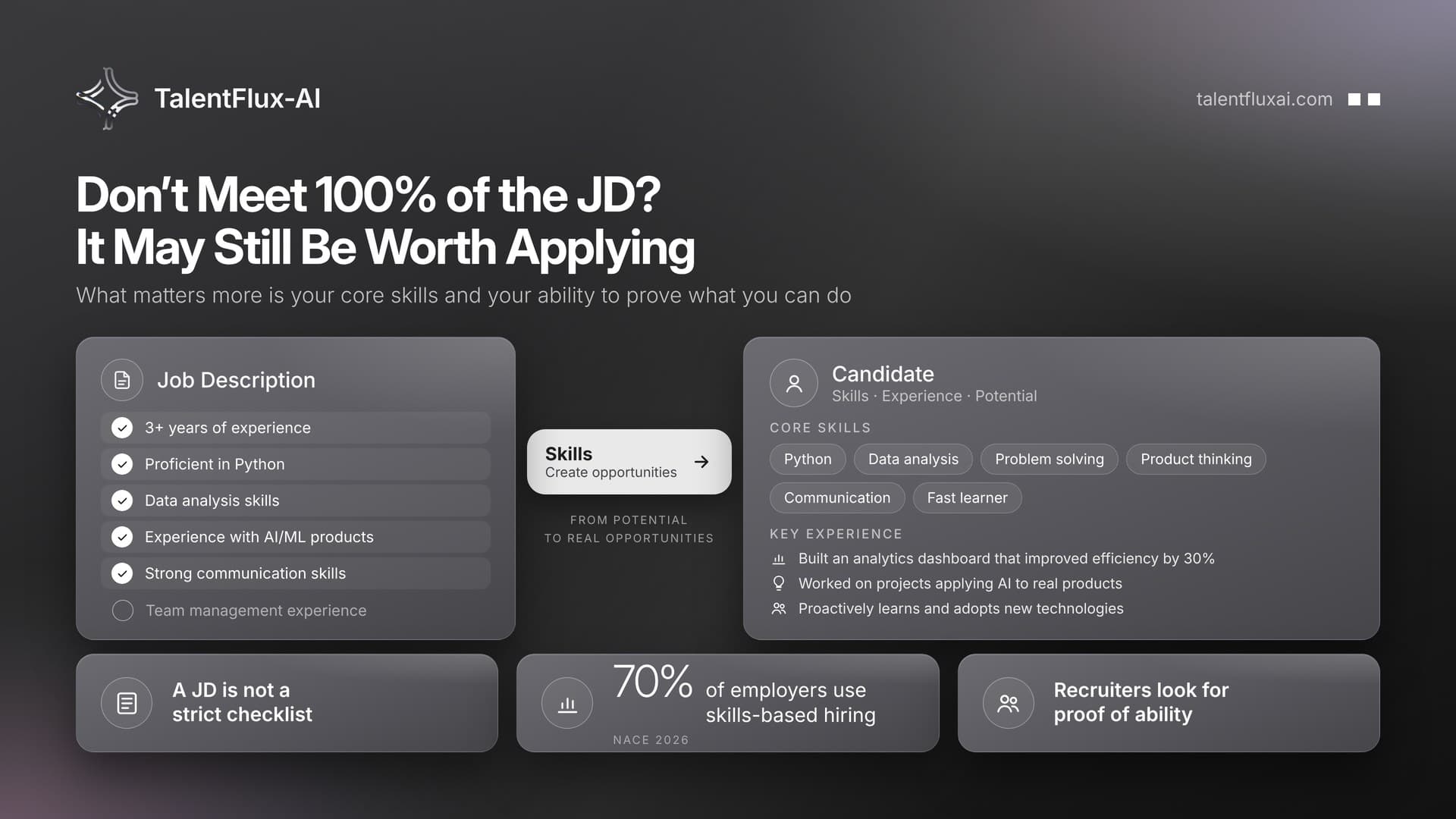
The short answer is: you might. A job description (JD) isn’t always a checklist where you have to tick every box before you’re allowed to apply. What matters more is working out which requirements are truly mandatory, which are flexible, and whether your current skills are enough to handle the core of the job.
Why Not Meeting 100% of a JD Isn’t Necessarily a Reason to Skip the Job
Hiring is moving toward practical ability and away from traditional signals like degrees or years of experience. According to NACE’s Job Outlook 2026 survey, 70% of responding employers said they use skills-based hiring for entry-level positions, up from about 65% the year before. Of the employers surveyed, 71% use this approach at least half the time in their hiring process.
Skills-based hiring doesn’t only show up at the interview stage. NACE reports that 65% of employers apply skills-based assessment as early as screening, and 87% use it in interviews. In other words, being able to show what you can do increasingly matters more than whether your résumé matches every line of the requirements.
Indeed also notes that if you don’t have the exact years of experience required but do have the knowledge and ability to handle the role’s main responsibilities, the job may still be worth applying for.
This doesn’t mean you should apply for every job you see. The point is to read the JD properly before deciding you’re “not qualified enough.”
First, Separate “Must-Haves” From “Nice-to-Haves”
Not every line in the Requirements section carries the same weight.
Even Indeed’s guidance for employers recommends clearly separating required qualifications from preferred qualifications. Required qualifications are the skills, certifications or experience truly needed to do the job. Preferred ones are areas where the company is willing to be flexible or provide training.
So when you read a JD, split the requirements into two groups.
Must-haves
These relate directly to your ability to do the job.
For example, a Content Writer role requires writing in English every day, but you can’t yet write English independently at a professional level. Or a specialist role requires a mandatory professional license that you don’t hold.
These gaps deserve serious thought before you apply.
Nice-to-haves
These criteria give candidates an edge but don’t necessarily decide the outcome.
You can spot them by phrases such as:
-
Preferred
-
A plus
-
Nice to have
-
Advantage
-
Familiarity with
-
Experience in X is preferred
Say the JD reads:
“Experience in SaaS industry is preferred.”
You’ve never worked in SaaS. But you have B2B marketing experience, have created content for a similar customer group, and understand how to build messaging for businesses.
You lack the industry experience, but you have plenty of relevant transferable skills. This job is still worth applying for.
Don’t Fixate on Years of Experience
“Minimum 2 years of experience.”
This is probably one of the lines that makes entry-level candidates and fresh graduates rule themselves out most often.
But years of experience don’t always equal proficiency.
Picture someone who has worked in marketing for one year. They have personally built content plans, written content, run campaigns, read performance reports and worked with many stakeholders. They may have covered a broader scope of work than someone with two years of experience who only handled one very narrow task.
LinkedIn also advises employers not to use years of experience or degrees as mechanical stand-ins for ability when a job can be assessed directly through skills. According to LinkedIn data published in 2024, about 70% of job descriptions on the platform included specific skills. Job posts that listed skills saw a view-to-apply rate nearly 20% higher than those that didn’t.
So instead of only asking:
“Do I have the full 2 years?”
Ask:
“How much of what this person does every day have I already done?”
A 3-Question Framework for Deciding Whether to Apply
There’s no exact number, like “apply if you meet 70%,” that works for every position.
Harvard Business Review has given an example: if a JD lists 10 criteria and you meet around 6–7 of them, the role may still be worth a shot. Treat this as a rule of thumb, not a fixed hiring formula.
Rather than calculating a percentage mechanically, answer these three questions.
1. Can you handle most of the core responsibilities?
Read the Responsibilities section before Requirements.
For example, a Marketing Intern needs to:
-
Create social media content
-
Design basic visuals
-
Research competitors
-
Track performance
-
Support campaigns
If you’ve done 4 of these 5 types of work through an internship, a student club or a project, your real fit may be higher than it first felt when you spotted one requirement you’re missing.
2. Can you learn what you’re missing in a reasonable amount of time?
Never used HubSpot, but familiar with another CRM?
Never used Looker Studio, but able to read data in Google Analytics?
Never worked in SaaS, but have worked in B2B?
These are all gaps you can likely close.
On the other hand, if the job requires deep specialist knowledge, a mandatory certification, or abilities you have no foundation in at all, the gap will be harder to bridge.
3. Do you have evidence for the skills you already have?
This is what decides whether your CV is convincing.
Don’t just write:
“Social Media Management.”
Show it:
“Planned and wrote 12 LinkedIn posts per month for a B2B brand, working with a designer to keep the posting schedule and campaign messaging consistent.”
You don’t need to prove you’re perfect.
You need to prove you’re close enough to the requirements to do the job and keep growing after onboarding.
(If you’re not sure how to turn projects, clubs, part-time jobs or internships into evidence of ability on your CV, see our article “CV for Students With No Experience” → internal link to be inserted once approved.)
How to Handle Missing Requirements on Your CV
A common mistake is trying to hide what you don’t have, or “upgrading” your experience so your CV looks like a closer match to the JD.
Don’t.
Instead, find the closest skill you actually have.
For example, the JD asks for:
“Experience managing LinkedIn content for B2B SaaS brands.”
You’ve never worked in SaaS, but you have managed LinkedIn for a B2B company.
Instead of skipping this requirement, lead with a bullet that shows your transferable experience:
“Planned and produced LinkedIn content targeting B2B decision-makers, translating product features into audience-focused messaging.”
Or the JD asks for:
“Experience with HubSpot.”
You haven’t used HubSpot, but you have used another CRM.
Your CV can name the tool you actually used and the work you did with it. In the interview, you can explain that you understand how CRMs work and are learning HubSpot.
A transferable skill beats a keyword that isn’t true.
When You Shouldn’t Force an Application
You can still apply without meeting 100% of a JD, but that doesn’t mean every gap can be ignored.
Consider not applying if:
-
You lack a certification or legal license that the job requires
-
You don’t meet the language requirement for a language the role uses every day
-
You’re missing core technical skills and have no equivalent skills
-
You can’t handle most of the responsibilities
-
The mandatory working conditions don’t suit you, such as schedule, location or onsite requirements
-
The role is senior, and your current experience is still far from the level of autonomy it requires
For example, being one year short of a “2–3 years of experience” requirement is completely different from applying for Head of Marketing when you’ve never run a campaign yourself.
The goal isn’t to apply to as many jobs as possible. It’s to avoid ruling yourself out of opportunities that are realistically within reach.
Read the JD in This Order Before You Hit Apply
Instead of reading Requirements first and panicking, try changing the order:
- Responsibilities: Can you do the main tasks?
- Required skills: Which skills are truly mandatory?
- Preferred skills: What counts as an extra advantage?
- Experience: Is the gap in years large or small?
- Tools: Do you know the main tools, or have experience with equivalent ones?
- Industry knowledge: Is this knowledge you need from day one, or can you learn it during onboarding?
- Working conditions: Do the location, schedule, language and work arrangement suit you?
After this, go back to your CV and move your most relevant experience to the most visible spots.
Common Mistakes to Avoid
-
Dropping a job as soon as you see one missing requirement, without reading the Responsibilities
-
Mechanically applying a “must meet 70%” or “80%” rule to every job
-
Applying despite missing core skills or a mandatory certification
-
Copying every keyword from the JD into your CV, even for skills you’ve never had
-
Looking only at your past job titles instead of finding transferable skills
-
Using one generic CV for every JD without reprioritizing your relevant experience
-
Trying to hide what you lack instead of highlighting what you genuinely do well
Conclusion
Not meeting 100% of the requirements in a JD doesn’t mean you’re not qualified to apply.
Instead of counting how many lines you can tick, look at the core responsibilities, the must-have skills and your real skill gap. If you can do most of the work, have evidence for the important skills, and can learn what’s missing in a reasonable time, the role may still be worth a try.
A JD describes the candidate a company wants to find.
Your CV needs to show how what you’ve already done equips you to do the job they need.
If you’re not sure your CV highlights the skills the JD is asking for, try TalentFlux-AI to build and optimize your CV, then check it against each JD before you apply.
References
- NACE (National Association of Colleges and Employers): Skills-Based Hiring Grows, but College Students Don’t Fully Understand It
- NACE: Employer Use of Skills-Based Hiring Practices Grows
- Indeed: 10 Tips for Applying for a Job With Less Experience Than Required
- Indeed: Things to Consider Before Posting Your Job: Clearly Separate Required and Preferred Qualifications
- Harvard Business Review: Should You Apply for a Job If You Don’t Meet Every Qualification?
- LinkedIn Talent Solutions: LinkedIn Data Points Out 2 Simple Ways to Improve Skills-Based Hiring