Remote Job Search: How to Find, Filter and Apply for Remote Jobs Effectively
Work from anywhere, skip the rush-hour commute, set your own schedule and maybe even work for a company overseas. It’s no surprise that “remote” is one of the first filters people switch on when they start looking for a job.
But many people quickly discover the other side. They send dozens of applications for remote roles and hear nothing back. Or worse, a “work from home, high income” posting turns out to be a scam.
The problem usually isn’t that you’re not good enough. Remote jobs work by a different logic: fewer openings, more competition, and employers looking for different signals than they would for an office role. This article will help you understand the market, find the right sources and prepare an application that improves your chances of getting an interview.
The Reality: Remote Jobs Are Scarcer and More Competitive
After the pandemic boom, many companies moved back to office-based or hybrid work. According to LinkedIn data from June 2025 reported by Fortune, only about 8.6% of job postings in the US were fully remote, and 13.1% were hybrid.
Meanwhile, demand from job seekers remains high. LinkedIn data from Ireland for the same period showed that each remote job posting received more than twice as many applications as traditional roles.
Put simply: there are fewer seats and more people who want them. That’s why “spraying” your CV at every job with the word remote in it rarely works. You need to be more selective and show employers why you’ll do well without sitting next to the team.
Understand What “Remote” Means Before You Apply
Not every job post that says “remote” means the same thing. Reading this part carefully saves you from wasting time on roles that don’t fit.
Common arrangements
- Fully remote: you work entirely from home and are never required to come into an office.
- Hybrid: a mix, for example 2–3 days a week in the office.
- Remote-first: the company builds its processes mainly around remote work. Documents, meetings and decisions all happen online.
- Remote-friendly: the company allows remote work, but its culture and processes still revolve around the office.
Conditions that often hide in the fine print
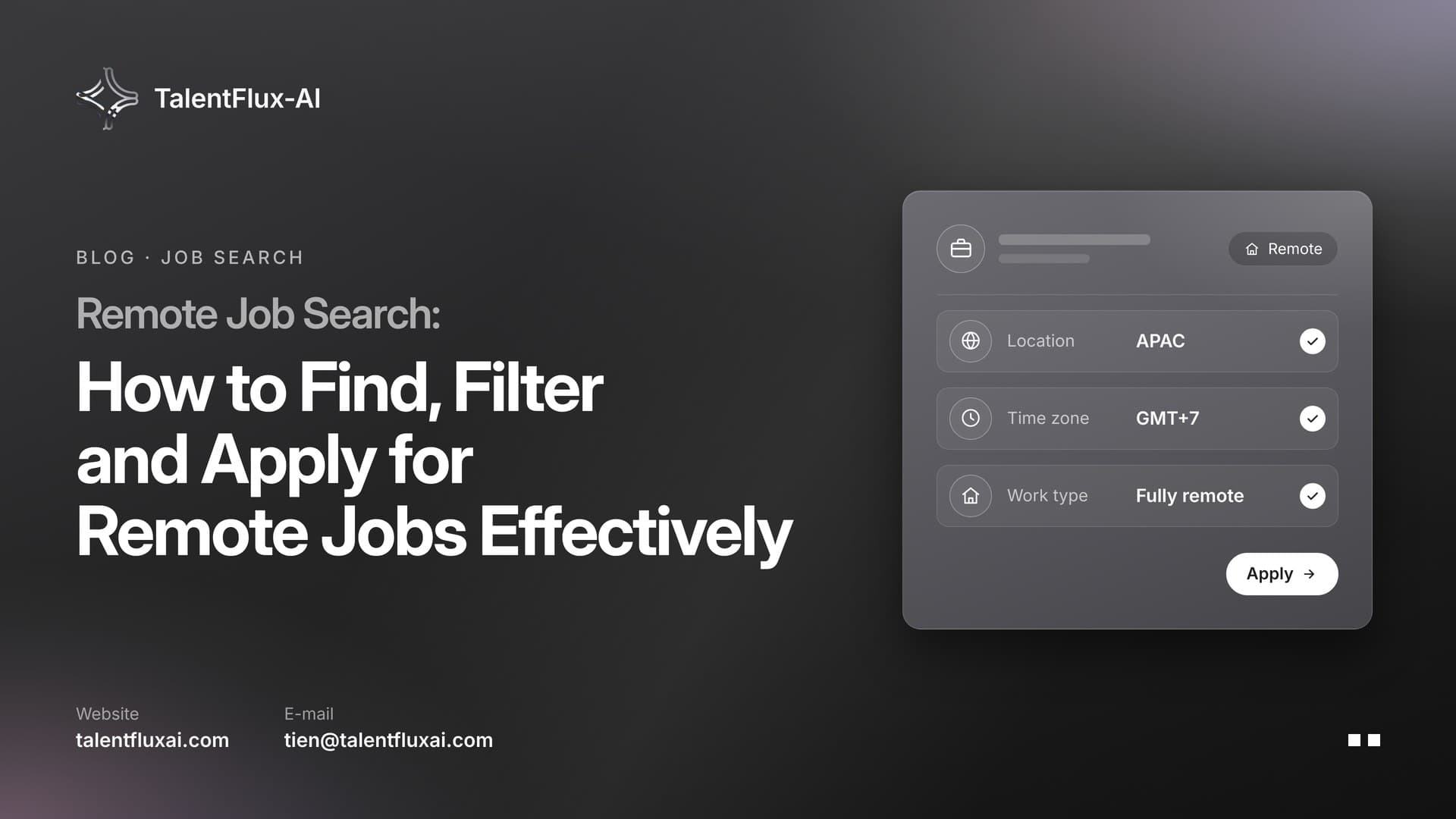
- Where you’re allowed to work from: “Remote (US only)”, “Remote – EU”, “Remote – APAC”. Many remote roles only hire people in certain countries for tax, contract or legal reasons.
- Time zone: a requirement to overlap a set number of hours with the team, for example “4 hours overlap with GMT+1”.
- In-person meetups: some remote roles still require offsites or quarterly office visits.
- Contract type: full-time employee, service contract or freelance. This affects your insurance, taxes and benefits.
- Equipment and costs: whether the company provides a laptop or covers internet or coworking costs.
If you’re based in Vietnam and the post says “Remote (US only),” that job isn’t for you, however attractive the description sounds.
Where to Find Remote Jobs
Use filters properly
On job platforms, don’t just switch on the “Remote” filter. Combine it with:
- Location: “Vietnam”, “Southeast Asia”, “APAC” or “Anywhere”
- Alternative keywords: “work from home”, “distributed team”, “location flexible”
- A specific level and field, instead of a broad search
Go straight to the careers pages of remote-first companies
Many remote companies post openings on their own careers page before listing them on major platforms. Building a list of companies you want to work for and checking them regularly often works better than scrolling through hundreds of listings a day.
Tap into professional communities
Professional groups, industry communities and your own network often share remote opportunities earlier. For remote roles, a referral from someone on the team carries a lot of weight, because it gives the employer more reason to trust that you work well independently.
What Remote Employers Are Really Looking For
When employers can’t watch you work every day, they look for evidence of these skills:
- Written communication: writing clearly and concisely, with enough context that others understand without a meeting.
- Self-management: planning your own work, prioritizing tasks and meeting deadlines without reminders.
- Proactive updates: reporting progress before anyone asks, and raising problems early instead of staying silent.
- Collaboration tools: Slack, Microsoft Teams, Notion, Jira, Trello, Google Workspace and similar.
- Working across time zones: knowing how to coordinate when your colleagues aren’t online at the same time.
Technical skills are still a requirement. But for remote roles, these skills are often what decides between two equally qualified candidates.
Writing a CV for Remote Jobs: Show, Don’t Just List
Writing “Works independently” or “Experienced in remote work” on your CV does almost nothing. Put the evidence in your experience section instead.
Instead of writing:
“Worked remotely for Company X.”
Write:
“Collaborated remotely with a 6-person team across 3 time zones, managed progress in Jira and ran weekly meetings, delivering 100% of releases on time over 6 months.”
If you’ve never worked remotely in a formal role, you still have plenty of experience you can use:
- Online group projects at university
- Freelance or part-time remote work
- Club or volunteer activities coordinated mainly through online tools
- Personal projects with concrete results and a portfolio or product to show
A few more tips:
- State your time zone and your ability to overlap with the team when applying to companies abroad.
- Put links to your portfolio, GitHub, writing or products near the top of your CV.
- Tailor your CV to each JD and move your remote collaboration experience to the most visible spots.
The Online Interview: Your First Remote Skills Test
An online interview is the first time an employer sees how you work remotely. Prepare by:
- Testing your connection, microphone, camera and lighting beforehand.
- Choosing a quiet space with a tidy background.
- Joining a few minutes early and sending a thank-you email afterwards.
You should also prepare answers to questions that often come up for remote roles:
- How do you manage your time and priorities when no one is supervising you?
- Tell us about a time you struggled to collaborate remotely and how you handled it.
- How do you keep your manager and colleagues updated on your progress?
- What does your home workspace look like?
Answer with specific examples: the situation, what you did and the result.
Watch Out for Remote Job Scams
Remote jobs are a common bait for recruitment scams. According to a Data Spotlight published by the US Federal Trade Commission (FTC) in December 2024, there were more than 20,000 job scam complaints in the first six months of 2024 alone, with losses of around $220 million. Nearly 40% of the money lost came from “task scams”: victims are given simple tasks, paid small rewards at first, then asked to deposit money to unlock the next tasks.
Warning signs to watch for:
- Any request for money: application fees, training fees, deposits, top-ups to “unlock tasks”
- Very simple work (liking posts, reviewing products, confirming orders) with unusually high pay
- An instant offer without a real interview
- Contact only through messaging apps, with no email from a company domain
- Requests for your ID, a selfie or your bank account number right at the start
- Impersonation of a well-known brand, with contact details that don’t match the official website
Before going further, check whether the posting appears on the company’s official careers page, look up the recruiter’s LinkedIn profile and verify the contact email. Legitimate employers don’t ask candidates to pay to get a job.
Checklist Before You Hit Apply on a Remote Job
- Location: Does the role hire people in your country?
- Time zone: Can you work during the hours that overlap with the team?
- Arrangement: Fully remote, hybrid, or are there in-person requirements?
- Contract: Employee or freelance? What benefits come with it?
- Skills: Do you have evidence of communication, self-management and collaboration tool skills?
- CV: Have you tailored it to the JD and moved your remote experience to the top?
- Legitimacy: Is the posting real, listed on official channels and free of any request for money?
Common Mistakes When Looking for Remote Jobs
- Applying to every post with “remote” in it without checking location and time zone requirements
- Using one generic CV for every role
- Writing “works well independently” with no example to back it up
- Taking the online interview lightly: a shaky connection, a noisy space, joining late
- Believing “easy work, high pay” offers and sending money upfront
Conclusion
Remote jobs aren’t easier to land than office jobs. With fewer openings and more competition, you need to be more selective and better prepared.
Read the remote conditions in each JD carefully and look for roles in the right places. On your CV and in interviews, show evidence that you communicate clearly, manage yourself well and collaborate effectively from a distance. And stay alert to offers that sound too good to be true.
If you want to find remote jobs that match your skills and optimize your CV for each role before applying, try TalentFlux-AI.
References
- Fortune: America’s return-to-office war and LinkedIn data on remote and hybrid job postings (July 2025)
- RTÉ: LinkedIn survey on remote jobs in Ireland (July 2025)
- TechRadar: Fake job tasks are costing victims millions, FTC warns (December 2024)
- FTC Data Spotlight: Paying to get paid: gamified job scams drive record losses (December 2024)