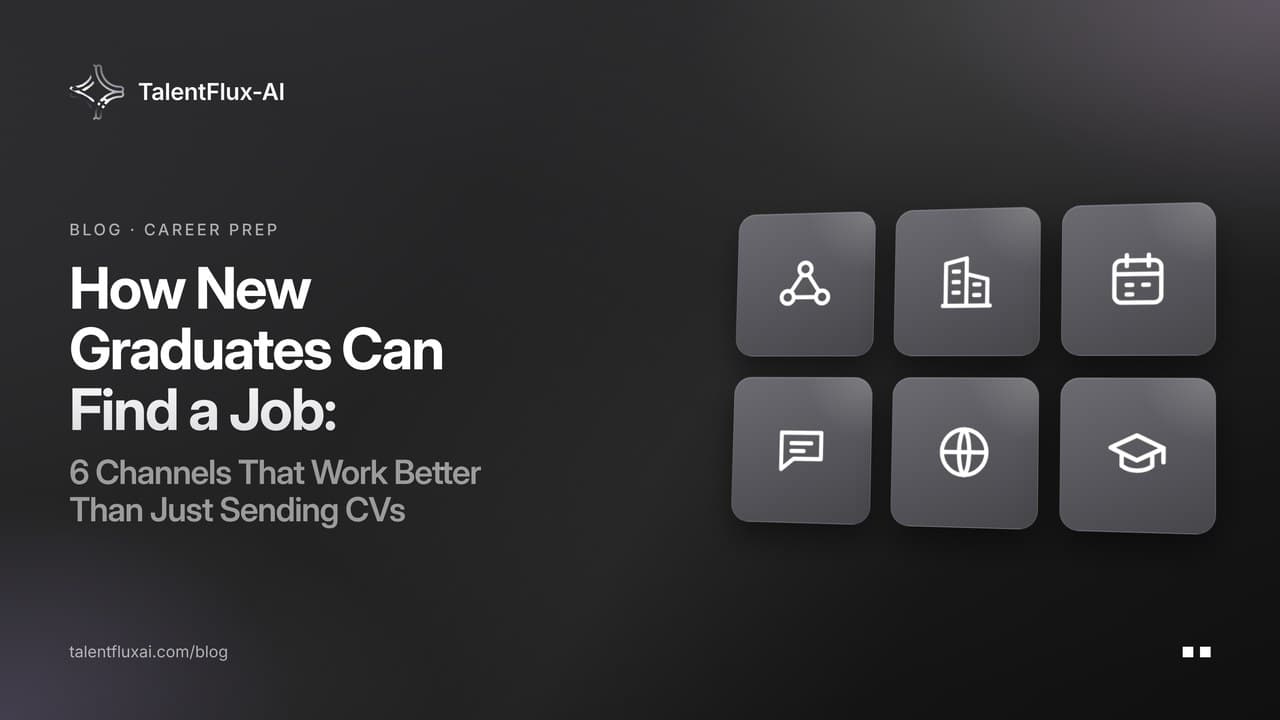
How to Find a Job as a New Graduate: 6 Channels That Work Better Than Just Sending CVs
You have sent dozens of applications, but all you got back were a few rejection emails, or no reply at all.
For new graduates, the problem usually isn't that you are not good enough. It's that your job search depends too much on one channel: open a job board, apply to as many roles as possible, then wait.
According to the National Statistics Office's report on the labour market in Q3/2026, the unemployment rate among young people aged 15-24 was 9.07%, much higher than the overall rate of 2.22%. The market is not easy, so your job search needs a clearer strategy.
This article covers 6 job search channels, how to track your applications, a 4-week plan and the warning signs of suspicious job ads.
1. Why do you get no replies after sending so many CVs?
Sending more applications does not mean getting more opportunities.
Some common reasons:
- Your CV doesn't match each role: the same CV goes to every job ad.
- You only use one channel: you miss opportunities that are never posted publicly.
- You don't track your applications: you forget where you applied and when to follow up.
- Your goal is unclear: applying for very different roles makes your profile lose focus.
The good news is that you can fix all four right away.
2. Summary: 6 job search channels for new graduates
| Channel | Best when | What to do | Note |
|---|---|---|---|
| Job boards | You need many options quickly | Turn on alerts by keyword and location | Tailor your CV to each ad |
| You want to reach recruiters directly | Complete your profile, send short and specific messages | Don't just click "Connect" | |
| Company websites and fanpages | You already have target companies | Check their careers page every week | You can send an introduction email |
| Personal network | You want to hear about unadvertised roles | Ask for advice, ask for referrals | Say thank you every time someone helps |
| Job fairs | You want to meet recruiters in person | Prepare a 30-second introduction | Send a thank-you note within 1-2 days |
| Internships and part-time jobs | You have no work experience yet | Choose a place with a mentor | Record your results to add to your CV |
3. Before you start: choose 2-3 target roles
Before opening any job board, pick two or three roles you want to try.
Example for a Marketing graduate:
- Content Executive
- Social Media Executive
- Marketing Executive
For each role, read 5-10 job ads and note the requirements that appear again and again.
Target role → Repeated requirements → Skills to build → Keywords to search
This step tells you how to tailor your CV and which keywords to use when searching.
4. 6 effective job search channels for new graduates
1. Job boards and job search apps
This is the most familiar channel. To use it well:
- Create a complete profile with a photo and clear contact details.
- Turn on new job alerts by keyword and location.
- Read the job description carefully before applying.
- Adjust the summary and skills sections of your CV to match each ad.
Tip: 5 carefully tailored applications usually work better than 30 identical ones.
2. LinkedIn
LinkedIn lets you see who posted the job and who works on the team. Update your:
- Profile photo: a clear face, a simple background.
- Headline: briefly say who you are, what you are good at and what you are looking for, for example "Marketing Graduate | Content & Social Media | Seeking Marketing Internship".
- About section: 3-4 sentences on your strengths and the role you want.
- Projects: coursework, internships and activities with concrete results.
When you message a recruiter or someone working in your target role, keep it short and specific:
"Hi [Name], I'm a recent Marketing graduate. I saw that your company is hiring a Content Executive and I'm very interested in the role. Could you share which skills your team usually looks for?"
3. Company websites and fanpages
Many companies post jobs on their own website or fanpage before posting anywhere else.
- Make a list of 10-15 companies you would like to work for.
- Check their careers page every week.
- If there is no suitable opening yet, send a short introduction email with your CV to the HR team.
4. Your personal network
Lecturers, older students and friends from your clubs often know about opportunities that are not advertised.
- Don't: ask straight away, "Is your company hiring?"
- Do: ask about their work, their workplace and their advice for newcomers, then ask for a referral if there is a suitable opening.
Don't forget to say thank you, even if the conversation doesn't lead to an opportunity yet.
5. Job fairs and career events
University job fairs, seminars and career talks let you meet recruiters in person.
Prepare a 30-second introduction → Bring your CV → Ask 1-2 specific questions → Get contact details → Send a thank-you note within 1-2 days
6. Internships and part-time jobs
If you haven't found a full-time job yet, an internship with a mentor can be a good stepping stone. Write down what you did and the results you achieved so you can add them to your CV later.
5. Tracking applications: how not to miss any opportunity
When you apply to many places, it's easy to forget where you applied and when to follow up. Create a simple spreadsheet like the example below (sample data for illustration only).
| Company | Role | Applied on | Channel | Status | Follow up |
|---|---|---|---|---|---|
| Company A | Content Executive | 03/11 | Waiting for reply | 10/11 | |
| Company B | Marketing Executive | 04/11 | Company website | Interview scheduled | Scheduled |
| Company C | Communications Executive | 05/11 | Referral | CV sent | 12/11 |
If you haven't heard back after about a week, you can send a short, polite follow-up email. Read more: Applying to many jobs at once: how to keep track of every application.
6. A 4-week job search plan
| Week | Goal | To do |
|---|---|---|
| Week 1 | Build the foundation | Choose 2-3 roles, tailor your CV, complete your LinkedIn profile |
| Week 2 | Expand your channels | List 15 companies, message 3-5 people in your network |
| Week 3 | Apply selectively | Send 5-10 tailored applications, update your tracking sheet |
| Week 4 | Follow up and practise interviews | Send follow-up emails, practise answers to common interview questions |
7. Warning signs of a suspicious job ad
First-time job seekers are easy targets for fake job ads. Stop and check carefully when you see these signs.
| Warning sign | Why it's suspicious | What to do |
|---|---|---|
| Asks you to pay a fee, a deposit or buy products | Legitimate employers don't charge candidates | Stop, don't transfer any money |
| Very high salary, vague job description | No clear information about the company or the job | Look up the company name, tax code and website |
| Only contacts you through personal messaging apps | Refuses to hold an interview or meet in person | Ask for a company email and a clear interview schedule |
| Asks for original documents from the start | Risk of losing documents and exposing personal data | Only provide copies when truly necessary |
8. Checklist for your first week of job searching
- Choose 2-3 target roles.
- Note the keywords and skills that repeat across job ads.
- Tailor your CV to each role.
- Complete your LinkedIn profile.
- List 10-15 target companies.
- Ask at least 3 people in your network for advice.
- Create an application tracking sheet.
- Schedule time to practise interviews.
9. Prepare for your job search with TalentFlux-AI
Once your applications start getting replies, the next step is preparing for interviews.
Tailor your CV → Write a cover letter → Practise mock interviews → Real interview
TalentFlux-AI helps you prepare your CV and cover letter and practise mock interviews with AI before you meet recruiters. You can also read 6 job interview tips for beginners.
👉 Start preparing your job search with TalentFlux-AI
FAQ: Common questions about finding a job as a new graduate
How many applications should I send each week?
There is no fixed number. Focus on the number of applications you can tailor your CV for, usually around 5-10 a week.
Should I apply for jobs that ask for "1 year of experience" if I have none?
You can, if you have related projects, internships or activities and describe them clearly in your CV. Experience requirements are often a preference, not a strict condition.
How long should I wait before following up?
About a week is reasonable. Send a short, polite email and mention the role you applied for.
Should I take a job outside my field?
It's worth considering if the job helps you build skills that support your long-term goals. Ask clearly about the actual tasks and growth opportunities.
How can I tell whether a company is trustworthy?
Check its website, tax code and reviews from employees, and ask people you know if possible. Don't transfer money or hand over original documents before signing a contract.
Conclusion
Finding your first job is not a race to see who sends the most applications. It's about finding the right channels, the right roles and following up consistently.
Remember these four things:
- Have a goal: choose 2-3 clear target roles.
- Use more channels: don't rely only on job boards.
- Track your applications: know where you stand in every process.
- Stay alert: check carefully before giving anyone money or documents.
Your first job won't define your whole career, but the way you look for it will help you take charge of every step that follows.