Structured Interviews: How to Build Interview Questions and a Candidate Scorecard
Two people interview the same candidate. One thinks the candidate is "great", the other thinks they are "not a good fit". When asked why, both answer based on gut feeling.
This happens often when every interviewer asks questions in their own way. The company finds it hard to compare candidates, and hiring decisions depend heavily on first impressions.
This article explains what a structured interview is and how to build interview questions, a rating scale and a scorecard so your hiring team can make more consistent decisions.
1. What is a structured interview?
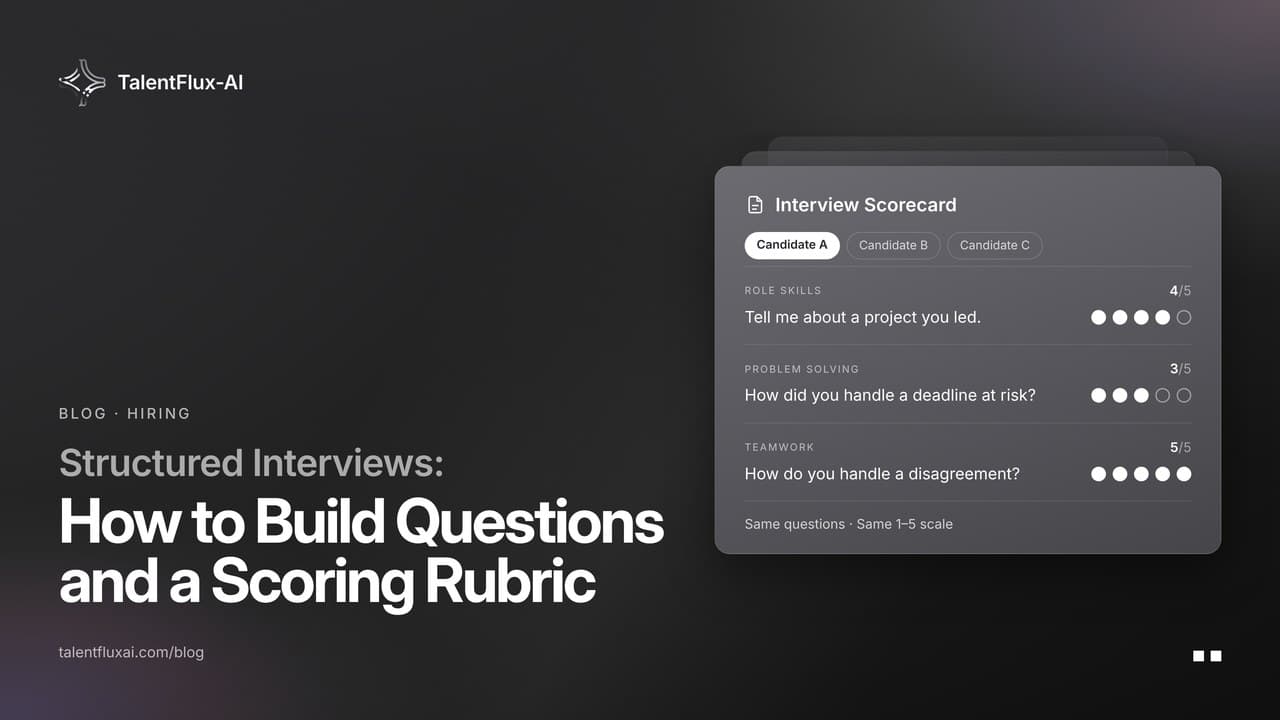
Structured interview: an interview in which every candidate for the same role is asked the same questions, in the same order, and scored on the same rating scale.
An unstructured interview, by contrast, is more like a free conversation. Each candidate gets different questions, which makes comparison difficult.
| Criteria | Unstructured interview | Structured interview |
|---|---|---|
| Questions | Each interviewer asks their own | One question set for the role |
| Scoring | Based on gut feeling | A rating scale with clear descriptions |
| Comparing candidates | Difficult | Easy, using the same criteria |
| Notes | Up to the interviewer | Recorded on a scorecard |
| Risk of bias | High | Lower |
2. Why should companies use structured interviews?
1. Fairer evaluation
Every candidate gets the same chance to answer the same questions, so the result depends less on whether they "click" with the interviewer.
2. Easier comparison and decisions
Scores for each criterion let the panel discuss evidence instead of arguing from impressions.
3. New interviewers can do it well too
Managers with little interviewing experience have ready-made questions, a rating scale and examples of good answers to refer to.
4. A better candidate experience
An interview that starts on time and stays focused shows candidates that the company is well prepared.
3. 5 steps to build a structured interview
Step 1: Choose 4-6 competencies to assess
Based on the job description, choose the competencies that matter most for doing the job well. For a Sales Executive role, for example: communication, handling objections, planning and accountability.
Step 2: Write 1-2 questions for each competency
There are two common question types:
-
Behavioural questions: ask about what the candidate has done. Example: "Tell me about a time a customer turned you down and how you handled it."
-
Situational questions: ask what the candidate would do. Example: "If a customer complains about the price in your first meeting, what would you do?"
For behavioural questions, candidates can answer using the STAR method: Situation, Task, Action, Result.
Step 3: Build a 1-5 rating scale with descriptions
Each score needs a specific description so that all interviewers understand it the same way.
| Score | Level | What the answer looks like |
|---|---|---|
| 1 | Not met | No specific example, or the answer is off topic |
| 2 | Needs improvement | An example, but the actions or results are unclear |
| 3 | Met | A relevant example, reasonable actions and acceptable results |
| 4 | Good | A clear example, proactive actions and measurable results |
| 5 | Excellent | A convincing example that shows the candidate learns and applies lessons |
Step 4: Create a scorecard
The scorecard lists the competencies, questions, a score box and a box for evidence notes. Each interviewer scores independently before the discussion.
Step 5: Agree on how the panel works together
Decide who asks about which competency, who takes notes and how much time is left for the candidate's questions at the end.
4. Example scorecard for a Sales Executive role
The table below is an illustration. Adjust it to the real requirements of the role.
| Competency | Question | Score (1-5) | Evidence notes |
|---|---|---|---|
| Communication | Introduce a product you have sold to a new customer. | ||
| Handling objections | Tell me about a time a customer said no and how you handled it. | ||
| Planning | How do you plan your customer outreach for a week? | ||
| Accountability | Tell me about a time you missed a target and what you did next. |
5. Mistakes to avoid
-
Judging in the first 5 minutes: a first impression can skew the scoring for the whole interview.
-
Asking too many off-script questions: candidates can no longer be compared fairly.
-
Discussing before scoring: the person with the strongest opinion influences everyone else.
-
Asking about private life: marital status, plans to have children or religion have nothing to do with ability to do the job.
6. Standardise your interview process with TalentFlux-AI
When several people take part in interviews, paper scorecards or scattered files are easy to lose and hard to combine.
Job description → Question set → Independent scoring → Combined results → Hiring decision
TalentFlux-AI helps companies manage candidates, interview schedules and evaluation results on one platform. Read more about talent management and HR trends in 2026.
👉 Explore TalentFlux-AI for businesses
FAQ: Structured interviews
Does a structured interview feel rigid?
Not necessarily. You can still ask follow-up questions to clarify an answer, as long as the main questions stay the same for every candidate.
How many questions should one interview have?
For a 45-60 minute interview, about 6-8 main questions works well, with time left for the candidate's questions.
Who should score the candidate?
Usually the hiring manager and one other interviewer, such as someone from HR or a colleague from the team.
Should the question set change over time?
Yes. Review it after each hiring round: which questions clearly separated strong candidates, and which ones should be replaced.
Conclusion
Structured interviews help companies evaluate candidates on evidence rather than impressions.
Remember four things:
-
Competencies: choose the 4-6 that matter most.
-
Questions: the same set for every candidate.
-
Rating scale: a clear description for each score.
-
Independent scoring: score first, discuss later.
A consistent interview process helps you choose the right people, and helps candidates trust that they were assessed fairly.