You have just found an internship at a foreign company. The job description is in English, but the CV on your laptop is the Vietnamese one you have used everywhere so far. Can you just translate it line by line? Not quite. A Vietnamese CV and an English CV differ in more than language: personal details, how experience is written, length, and what recruiters expect to see all change. This guide shows when to use each version, what to change when you move from one to the other, and how to keep both in sync without rewriting from scratch every time you apply.
1. When should you use a Vietnamese CV, and when an English one?
The short rule: send your CV in the language of the job description, unless the posting asks otherwise. An English JD gets an English CV; a Vietnamese JD gets a Vietnamese CV.
A few specific cases:
- Vietnamese company, Vietnamese JD: send a Vietnamese CV. An English version does not make you look more impressive; it only slows the reader down.
- Foreign company or multinational, English JD: send an English CV, even if the first-round interviewer is Vietnamese. CVs are often forwarded to managers in other countries.
- Bilingual JD, or "an English CV is a plus": send the English version, or attach both if the system accepts several files.
- Roles that need strong English (international customer service, marketing for overseas markets): your English CV is the first test of that skill.
If you are not sure, ask the recruiter directly or reply in the language of their first email or message.
2. Personal details: the biggest difference
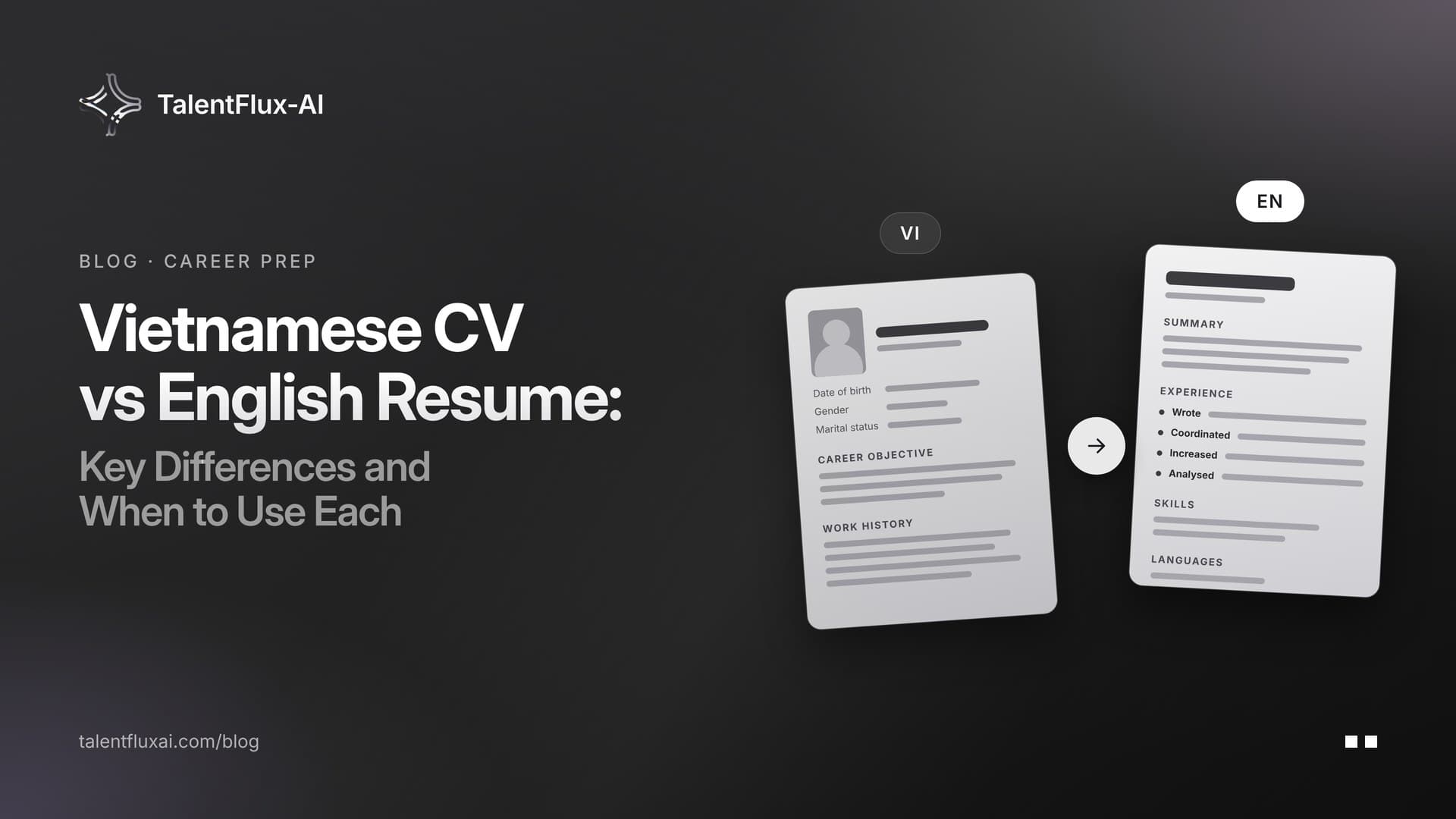
An English CV written to international norms leaves out personal details that say nothing about your ability, while Vietnamese CVs traditionally list everything.
| Information | Vietnamese CV (common habit) | English CV (international norm) |
|---|---|---|
| Photo | Usually included | Usually left out, unless the JD asks |
| Date of birth, gender | Usually included | Usually left out |
| Marital status, hometown | Sometimes included | Left out |
| National ID number, full address | Should not be included | Not included |
| Email, phone, city | Included | Included |
| LinkedIn, portfolio, GitHub links | Recommended | Recommended |
Even on a Vietnamese CV, you are not required to give your date of birth, gender or marital status. Vietnam's 2019 Labour Code bans discrimination at work (Article 8, clause 1), including discrimination based on gender, age and marital status (Article 3, clause 8). These details do not make your CV stronger; they only take space away from your skills and results.
On personal data: since 1 January 2026, Vietnam's Personal Data Protection Law No. 91/2025/QH15 has been in force. The more places you send your CV, the further its details travel, so include only what an employer needs to contact and assess you. Never include your national ID number.
3. Career objective vs professional summary
Vietnamese CVs usually have a "Career objective": what you want in the next 1-3 years. English CVs today favour a "Professional Summary": what you bring to this role, in 2-3 sentences.
The same person, written two ways:
- Objective (the habit): "Looking for a dynamic, professional environment where I can learn and grow."
- Summary (use it in both versions): "Final-year Marketing student who ran 2 social media campaigns for a student club, reaching over 3,000 engagements. Skilled in Canva and Meta Ads Manager, applying for the Marketing Intern role."
Anyone can write the first one, so it does not help a recruiter tell you apart. The second names your field, what you have done, a number, your tools and the role you want. For more on this section, read How to Write an Impressive Career Objective and Professional Summary for Your CV.
4. Work experience: don't translate word for word
This is where a machine-translated CV shows the most. An English CV writes each experience line as strong verb + what you did + result, with no subject and no "I".
| Vietnamese CV (translated literally) | English CV (rewritten properly) |
|---|---|
| "I was in charge of writing posts for the company fanpage." | "Wrote 12 posts a month for the company fanpage, growing followers from 2,000 to 3,500 in 4 months." |
| "Participated in supporting event organisation." | "Coordinated logistics for a 200-person career fair with a team of 5." |
| "Responsible for customer care." | "Handled 40+ customer requests a day by phone and chat." |
Three things to remember:
- Start with a past-tense verb for finished work: wrote, built, coordinated, analysed, increased.
- Add numbers wherever you can: amounts, percentages, time, team size.
- Don't translate job titles literally. "Cộng tác viên nội dung" should be "Content Writer (Part-time)", not "Content Collaborator".
This formula improves your Vietnamese CV too. If your Vietnamese version is full of "phụ trách", "tham gia", "hỗ trợ" (in charge of, participated in, supported), rewrite it the same way: "Viết 12 bài/tháng cho fanpage, tăng lượt theo dõi từ 2.000 lên 3.500 trong 4 tháng."
5. Education, skills and certificates
Education: use the official English name your university publishes; don't translate it yourself. State the GPA scale clearly, for example "GPA 3.4/4.0" or "GPA 8.2/10", so a foreign reader does not have to guess.
Skills: separate hard skills (Excel, SQL, Figma, Google Analytics) from soft skills. On an English CV, state language levels with a certificate or a specific level ("IELTS 7.0", "Japanese - JLPT N3") instead of "Good English".
Certificates and courses: give the original name, the issuer and the year. Don't translate the names of international certificates into Vietnamese on the Vietnamese version; keep the original name, because recruiters often search for exactly that.
6. Length, format and file name
- Length: students and people with under 3 years of experience should keep the CV to 1 page in both languages. Written with the formula in section 4, the English version is usually shorter than the Vietnamese one, so if your translation runs longer, look for sentences still translated word for word.
- Format: a single column, a readable font, and nothing important inside complex tables or images, so applicant tracking systems (ATS) can read it. See How to Write an ATS-Friendly CV in 2026 for details.
- File name: include your full name and the language, for example "NguyenVanAn_CV_EN.pdf" and "NguyenVanAn_CV_VI.pdf". Always send a PDF unless the JD asks for another format.
If you want a ready-made layout to start from, see 10 Professional Vietnamese CV Templates for 2026.
7. Checklist: turning a Vietnamese CV into an English one
Before you send the English version, go through this list:
- Photo, date of birth, gender and marital status removed (unless the JD asks for them)
- No national ID number or full street address
- A 2-3 sentence Summary that says what you bring to the role
- Every experience line starts with a past-tense verb, with no "I"
- At least 3 numbers in the experience section
- Job titles, university and certificate names use their official English names
- GPA shown with its scale
- Languages shown with a certificate or a specific level
- No sentence that sounds like a word-for-word translation (read it aloud to check)
- Still 1 page, saved as a PDF, file name includes your name and "EN"
8. Frequently asked questions
Does an English CV need a photo?
Usually not. Most foreign companies do not ask for one, and many encourage leaving it out to avoid bias. Add a photo only when the JD clearly asks for it.
Should I send both the Vietnamese and English CV at the same time?
Only when the JD is bilingual or the system lets you attach several files. Otherwise, send one version in the JD's language so the reader does not have to choose.
Can I use a translation tool or AI to translate my CV?
Yes, but only as a first draft. After translating, rewrite each experience line as verb + what you did + result, and read it aloud to remove word-for-word phrasing.
Does a Vietnamese CV have to include my date of birth?
No. Vietnam's 2019 Labour Code bans discrimination based on age, gender and marital status, so you can leave these out and use the space for skills and results.
Conclusion
A Vietnamese CV and an English CV should be two versions written for two different readers, not one CV and its translation. Keep the same core content (experience, numbers, skills), then adjust personal details, how each line is written and how things are named to fit each reader's expectations. Do it properly once, and you will have two versions ready for both Vietnamese companies and foreign employers.
Want to do it faster? On TalentFlux-AI, you can build your CV with AI, score it against ATS criteria and practise a mock interview before you apply.
Information about legal rules in this article is for reference only and is not a substitute for legal advice.