As the Lunar New Year (Tet) approaches, one question frequently comes up in Vietnamese workplaces: Will employees receive a 13th-month salary this year?
Many employees assume that this payment is required by law, while some employers and HR professionals may be unsure about their legal obligations.
In Vietnam, the 13th-month salary is a common year-end benefit, but it is not automatically mandatory under the law. Whether an employee is entitled to receive it depends on the company's bonus policy and any commitments made in relevant employment documents.
This article explains what a 13th-month salary is, whether employers are legally required to pay it, how it is commonly calculated, and how it is treated for personal income tax and social insurance purposes under Vietnam's regulations.
1. What Is a 13th-Month Salary?
A 13th-month salary is a year-end payment that employers commonly provide to employees, usually before the Lunar New Year (Tet).
In practice, the amount is often equivalent to one month's salary for employees who have worked for a full year. However, the actual amount and eligibility conditions depend on each company's bonus policy.
Although it is commonly called a "13th-month salary" (lương tháng 13), Vietnamese labour law does not define it as a separate mandatory salary payment. Instead, it is generally treated as a form of bonus under Article 104 of the Labour Code 2019.
Accordingly, the payment may be based on:
- The company's annual business performance.
- The employee's individual performance.
- The employee's length of service.
- The company's financial position.
- Other eligibility criteria specified in the company's bonus policy.
13th-Month Salary vs. Tet Bonus: What Is the Difference?
The terms "13th-month salary" and "Tet bonus" are sometimes used interchangeably. However, they are not necessarily the same.
| Criteria | 13th-Month Salary | Tet Bonus |
|---|---|---|
| Common purpose | Year-end employee benefit | Reward for the Lunar New Year |
| Calculation | Often based on one month's salary | Determined by company policy |
| Amount | Commonly equivalent to one month's salary | May vary depending on business and individual performance |
| Payment time | Usually at year-end | Usually before Tet |
| Legal classification | Generally treated as a bonus | Bonus under Article 104 of the Labour Code |
The key distinction is that a 13th-month salary is commonly calculated based on an employee's monthly salary, while a Tet bonus may be a fixed amount, a performance-based payment, or another form of reward.
Companies may provide both benefits, only one of them, or neither, depending on their policies and commitments.
2. Is a 13th-Month Salary Mandatory in Vietnam?
No. Vietnamese labour law does not generally require employers to pay a 13th-month salary.
The legal basis is Article 104 of the Labour Code 2019 (Law No. 45/2019/QH14), which regulates employee bonuses.
Under this provision, a bonus refers to money, property, or other forms of reward that an employer gives to employees based on:
- The company's production and business results.
- The employee's level of work completion.
The employer has the authority to establish its bonus regulations, but must publicly announce them at the workplace after consulting the employee representative organisation at the workplace, if one exists.
This means that companies can determine whether to provide a 13th-month salary, how much to pay, and which employees are eligible, subject to applicable legal requirements and any binding commitments.
When Does a Company Have to Pay a 13th-Month Salary?
Although the law does not make this payment universally mandatory, an employer may become obligated to pay it if the payment has been committed to in relevant employment documents or company policies.
Employees should review the following documents:
1. Employment contract
If the employment contract explicitly provides for a 13th-month salary or a year-end bonus, the employer must consider and comply with that commitment.
2. Collective labour agreement
A collective labour agreement may establish bonus entitlements and payment conditions applicable to employees covered by the agreement.
3. Company bonus regulations
The company's published bonus policy may specify eligibility requirements, calculation methods, performance criteria, and payment schedules.
Therefore, employees should not assume that a 13th-month salary is automatically guaranteed simply because it is common practice in Vietnam. The actual entitlement depends on the applicable documents and whether the employee meets the stated conditions.
3. How Is the 13th-Month Salary Calculated?
There is no single calculation formula prescribed by Vietnamese labour law.
In practice, many companies calculate the 13th-month salary based on the employee's monthly salary and the number of months worked during the year.
A commonly used reference formula is:
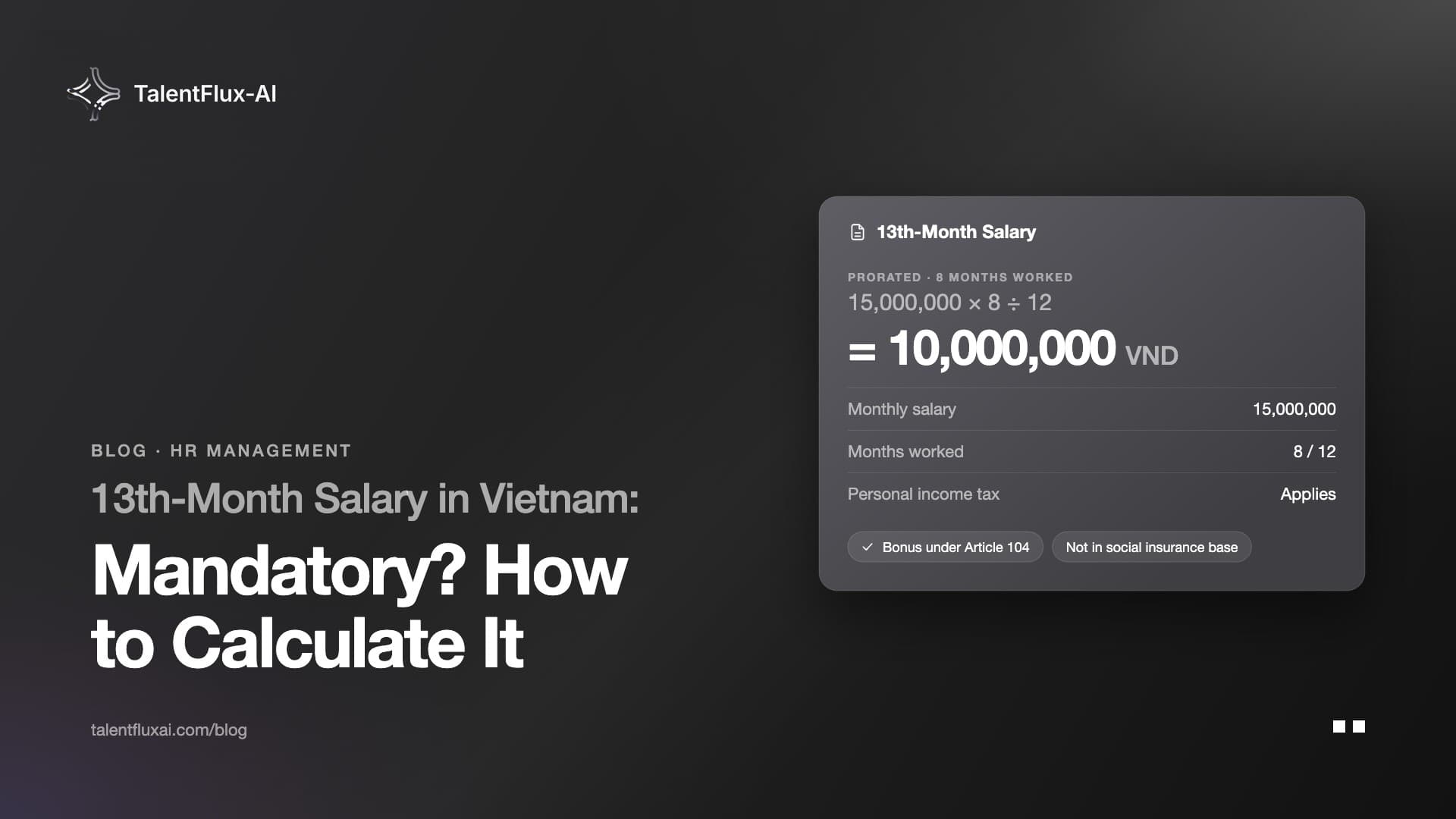
13th-Month Salary = Average Monthly Salary × (Actual Months Worked / 12)
This is a common company practice, not a mandatory statutory formula. Employers should follow the calculation method specified in their bonus regulations or other applicable agreements.
Example: Employee Who Worked a Full Year
Suppose an employee has:
- Monthly salary: VND 15,000,000
- Actual working period: 12 months
- Bonus policy: One month's salary for a full year of service
The calculation is:
VND 15,000,000 × (12 / 12) = VND 15,000,000
The employee receives a 13th-month salary of VND 15,000,000.
Example: Employee Who Worked Less Than 12 Months
Suppose another employee has:
- Monthly salary: VND 12,000,000
- Actual working period: 8 months
- Bonus policy: Pro-rated payment based on months worked
The calculation is:
VND 12,000,000 × (8 / 12) = VND 8,000,000
The employee receives a 13th-month salary of VND 8,000,000.
These examples illustrate a common pro-rated approach. The actual payment may differ depending on the company's policy, salary reference period, performance conditions, and eligibility requirements.
4. Who Is Eligible for a 13th-Month Salary?
Eligibility is generally determined by the company's bonus regulations rather than a universal legal requirement.
However, several employment situations commonly raise questions.
Employees Who Have Not Completed One Year of Service
Employees who joined during the year may receive a pro-rated bonus if the company's policy allows it.
Some companies calculate the payment based on the number of months worked, while others apply different eligibility conditions.
Employees on Probation
Employees on probation are not automatically entitled to a 13th-month salary.
Their eligibility depends on the employment agreement, the company's bonus policy, and whether probationary service is included in the calculation period.
Employees Who Resign Before Tet
Employees who resign before the bonus payment date may or may not receive a 13th-month salary.
The answer depends on the conditions stated in the company's bonus policy or other binding agreements. For example, a policy may require employees to remain employed on a specified date to qualify for payment.
Employees should review these conditions before assuming they are entitled to a full or pro-rated bonus.
Employees on Maternity Leave or Unpaid Leave
Employees taking maternity leave or unpaid leave should check how the company calculates the bonus during periods when they are not actively working.
The policy may account for actual working time, eligible leave periods, or other criteria. There is no universal pro-rating formula for every company.
5. Is the 13th-Month Salary Subject to Personal Income Tax?
Yes. A 13th-month salary is generally subject to personal income tax (PIT) in Vietnam.
Under Vietnam's personal income tax regulations, bonuses received in connection with employment are generally treated as taxable income from salaries and wages, unless a specific exemption applies.
This means that a 13th-month salary is generally included in the employee's taxable employment income.
When Is Personal Income Tax Calculated?
For employees receiving a 13th-month salary as a lump-sum payment, the bonus is generally included in taxable employment income in the period in which it is paid.
For example:
- If the company pays the bonus in December 2026, it is generally included in the employee's 2026 taxable income.
- If the company pays the bonus in January 2027, it is generally included in the employee's 2027 taxable income.
The actual tax payable depends on the employee's total taxable income, eligible deductions, tax residency status, and applicable tax rules.
Employees should therefore distinguish between the gross bonus amount and the net amount they receive after tax withholding.
6. Does the 13th-Month Salary Count Towards Social Insurance Contributions?
Generally, a properly classified 13th-month bonus is not included in the compulsory social insurance contribution base.
Under Article 31 of the Law on Social Insurance 2024 (Law No. 41/2024/QH15), the contribution base for employees subject to the relevant provisions is determined by reference to monthly salary, including salary for the job or position, salary allowances, and other additional amounts that are agreed to be paid regularly and consistently in each pay period.
Article 7 of Decree No. 158/2025/ND-CP provides further guidance on the salary used as the basis for compulsory social insurance contributions.
A year-end bonus that is genuinely paid as a separate bonus, rather than a regular and stable salary component, is generally excluded from this contribution base.
However, employers should carefully distinguish between a genuine bonus and an additional salary payment that is regularly agreed upon in the employment contract.
The legal treatment depends on the nature and documentation of the payment, not simply the name used by the company.
7. What Should Employees Check Before Receiving Their 13th-Month Salary?
Before the year-end payment period, employees should review their employment documents and understand the company's bonus policy.
Here are several important points to check:
- Eligibility: Does the policy require a minimum length of service or a specific employment status?
- Calculation method: Is the bonus based on the basic salary, actual monthly salary, average salary, or another reference amount?
- Performance conditions: Does the company consider individual or business performance?
- Payment date: When will the bonus be paid?
- Resignation conditions: Are employees who resign before the payment date still eligible?
- Tax deductions: Is the announced amount gross or net of personal income tax?
Understanding these conditions can help employees estimate their year-end income and avoid misunderstandings with their employers.
8. How Can HR Manage 13th-Month Salary and Year-End Bonuses More Effectively?
For HR departments, year-end bonus management involves more than calculating payments. It also requires accurate employee data, clear policies, budget planning, and transparent communication.
Here are several practices companies can consider:
1. Establish clear bonus regulations
Define eligibility criteria, calculation methods, performance conditions, and payment schedules in a written bonus policy.
2. Plan the annual bonus budget
Estimate the expected bonus expense based on employee headcount, salary levels, business performance, and the company's financial capacity.
3. Maintain accurate employee records
Keep employee information, salary history, working periods, and performance records updated to reduce calculation errors.
4. Ensure payroll and tax compliance
Review applicable personal income tax and social insurance regulations before processing year-end payments.
5. Communicate policies transparently
Inform employees about eligibility requirements, calculation methods, and payment timelines to reduce confusion and disputes.
HR teams can also use an HR management system to centralise employee records, monitor payroll-related information, and streamline administrative processes.
With TalentFlux-AI, businesses can explore AI-powered workforce management solutions to support HR operations and improve the efficiency of employee management.
Frequently Asked Questions (FAQs)
1. Is a 13th-month salary compulsory in Vietnam?
No. Vietnamese labour law does not require every employer to pay a 13th-month salary. However, an employer may be obligated to pay it if the benefit has been committed to under an applicable employment contract, collective labour agreement, or company bonus policy.
2. Is a 13th-month salary the same as a Tet bonus?
Not necessarily. A 13th-month salary is commonly calculated based on one month's salary, while a Tet bonus may be determined by company performance, individual performance, or other criteria. Both are generally treated as bonuses under Vietnamese labour law.
3. Can employees who have worked for less than one year receive a 13th-month salary?
Yes, if the company's bonus policy allows it. Some employers calculate the payment proportionally based on the number of months worked, but this is not a mandatory formula under Vietnamese law.
4. Do employees on probation receive a 13th-month salary?
Not automatically. Their eligibility depends on the employment agreement and the company's bonus regulations, including whether probationary service is counted towards the bonus period.
5. Is the 13th-month salary subject to personal income tax?
Yes. A 13th-month salary is generally considered taxable employment income. The applicable tax is determined based on the employee's taxable income and relevant deductions.
6. Is the 13th-month salary subject to social insurance contributions?
Generally, no, provided that it is a genuine bonus and is not classified as a regular and stable salary component included in the compulsory social insurance contribution base.
7. Can an employer refuse to pay a 13th-month salary?
An employer is not generally required by law to provide this payment. However, if the employer has made a binding commitment to pay it and the employee satisfies the applicable conditions, the employer must comply with that commitment.
Conclusion
The 13th-month salary is a common year-end benefit in Vietnam, but it is not a universal statutory entitlement.
For employees, understanding the company's bonus policy and checking the relevant employment documents are essential to knowing whether they qualify for the payment.
For employers and HR professionals, establishing transparent bonus regulations, planning budgets, maintaining accurate employee records, and complying with tax and social insurance requirements can make year-end payroll management more effective.
As workplace expectations and HR operations continue to evolve, having clear policies and reliable management processes can help businesses build trust with employees while maintaining operational efficiency.
Disclaimer: This article provides general information about Vietnamese labour, tax, and social insurance regulations. It should not be considered legal, tax, or professional advice for a specific case. Employers and employees should refer to the latest applicable regulations and seek professional guidance when necessary.
References
- Labour Code 2019 – Law No. 45/2019/QH14, Article 104: Bonuses.
https://vanban.chinhphu.vn/?classid=1&docid=198540&pageid=27160 - Personal Income Tax Law 2025 – Law No. 109/2025/QH15: Applicable rules on taxable income from salaries, wages, and bonuses.
https://vanban.chinhphu.vn/?classid=1&docid=216495&orggroupid=1&pageid=27160 - Law on Social Insurance 2024 – Law No. 41/2024/QH15, Article 31: Salary used as the basis for compulsory social insurance contributions.
https://xaydungchinhsach.chinhphu.vn/toan-van-luat-so-41-2024-qh15-bao-hiem-xa-hoi-119240723163650489.htm - Decree No. 158/2025/ND-CP, Article 7: Details on the salary used as the basis for compulsory social insurance contributions.
https://xaydungchinhsach.chinhphu.vn/toan-van-nghi-dinh-158-2025-nd-cp-quy-dinh-ve-bao-hiem-xa-hoi-bat-buoc-119250629171336803.htm