Harvard CV or 2-Column CV: Which Template Gets Past AI Screening (2026)?
Harvard CV or 2-column CV with a photo: why the choice matters
Search for CV templates online and you'll find two familiar styles: the black-and-white, text-only Harvard CV, and the 2-column CV with a photo, colors and icons. Each has its fans and critics, so many people aren't sure which one to pick.
The choice matters because your CV usually has two "readers". The first is applicant tracking software (ATS): according to Greenhouse data compiled by Novorésumé, 53% of US recruiters have handed most CV screening to AI or ATS tools. The second is the recruiter, and 42% of them spend under 10 seconds on the first pass.
Each style suits a different group of employers. This article compares the two in detail and helps you choose based on where you're applying.
What is a Harvard CV?
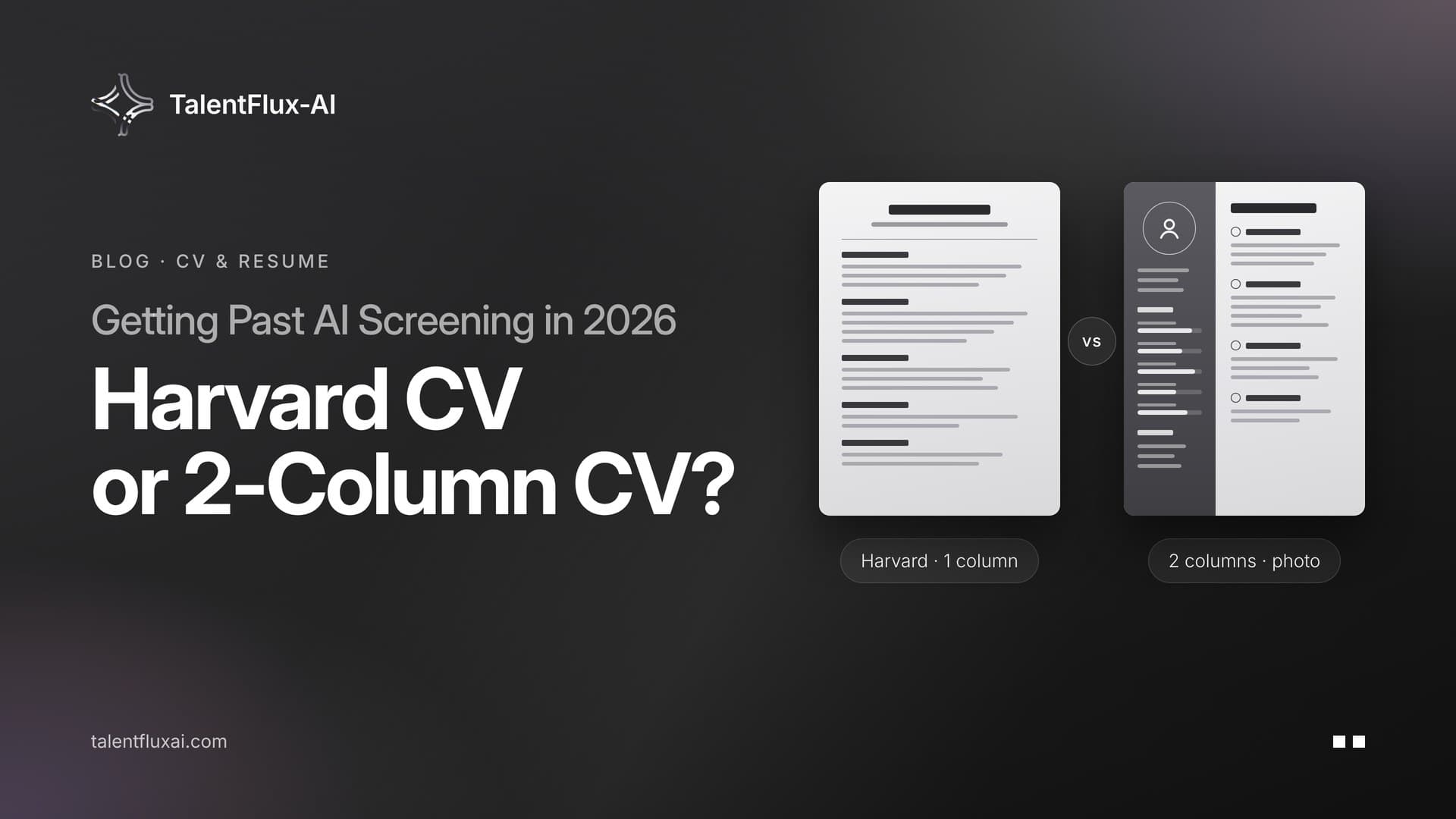
A Harvard CV follows the guidelines of Harvard University's career center (the Mignone Center for Career Success). Its hallmarks: one column, black text on a white background, no photo and no icons.
Harvard CV structure:
- Contact details: full name, email, phone number
- Education
- Experience
- Leadership & Activities
- Skills & Interests
Within each section, entries run in reverse chronological order. Harvard also advises ordering sections by their importance to the role, so experienced professionals can put Experience ahead of Education.
Each line starts with an action verb and states a clear result, in keeping with Harvard's advice to write "to inform, not to impress".
Pros:
-
Applicant tracking systems (ATS) read it accurately because the layout is a single top-to-bottom flow of text
-
Looks clean and professional, easy to skim
-
Recruiters focus straight on the content
Cons:
-
With no colors or images to support it, your CV is only as strong as every line you write
-
Can look like hundreds of other CVs if the content is generic

What is a 2-column CV with a photo?
A 2-column CV splits the page into two areas. The left column is usually shaded and holds your photo, contact details and skills. The right column covers experience, education and certifications, with an icon for each section. These templates are available on many CV builder sites, so you just fill in your details.
Pros:
-
Stands out and makes a strong first impression
-
Fits a lot of information on one page
-
Quick to make with ready-made templates
Cons:
-
Can be read in the wrong order. In a test by ATS Verification (June 2026), the 2-column CV was the only one of six layouts flagged with a critical error: the parser read across each row and mixed the sidebar into the work history. Its score dropped from 100 to 85.
-
Employer names can be misattributed. A 357-run test by Enhancv found modern tools recover all the words in both layouts. But even with AI parsing, employer names in 2-column CVs were attributed correctly only 83% of the time, versus 100% for single-column CVs.
-
Skill bars and star ratings look nice but don't tell employers what you can actually do.
In other words, a 2-column CV isn't automatically rejected. The risk depends on the employer's software and how the file is built, and candidates usually can't know either in advance.

Harvard CV vs 2-column CV at a glance
| Criteria | Harvard CV | 2-column CV with a photo |
|---|---|---|
| Layout | 1 column, top to bottom | 2 columns, shaded side column |
| Photo, colors, icons | No | Yes |
| ATS readability | Reliable on most systems | Depends on the software; may read out of order or misattribute employer names |
| Visual impression | Simple, professional | Eye-catching, personal |
| Strength | Content, measurable achievements | Design, lots of information on 1 page |
| Best for | Corporations, foreign companies, banks, consulting firms, online application portals | Creative fields, service roles, small companies accepting CVs by email |
Harvard CV or 2-column CV? Choose based on where you apply
The right question isn't "which template looks better", but "who will read my CV first".
Use a Harvard CV when:
-
Applying to large corporations, foreign companies, banks or consulting firms
-
Submitting through an online application portal (a company careers page or a job board)
-
Applying for roles with many candidates, where employers almost certainly screen with software
Use a 2-column CV with a photo when:
-
Applying in creative fields (design, communications, marketing), where the CV itself shows your taste
-
Applying for service roles where appearance matters (receptionist, flight attendant, in-store sales)
-
Emailing your CV to a small company, where the first reader is a person
If you use a 2-column CV, reduce the risk:
-
Put your key experience and skills in the main column; keep important information out of the colored column
-
Let your name and contact details run across the full width of the page header
-
Avoid placing text in text boxes, tables or images
-
Copy the whole CV into Notepad: if the text comes out in the right order, software is likely to read it correctly too
Tip: prepare both versions with the same content. Use the Harvard version for online portals and the 2-column version for email applications or to bring to interviews.
5 tips for an ATS-friendly Harvard CV
Since a Harvard CV has no design to lean on, everything rests on the content. These tips are based on Harvard's guidance:
- Start each line with an action verb: "Built", "Optimized", "Led" instead of "Responsible for".
- Quantify results: "Raised landing page conversion from 2% to 3.5% in 3 months" beats "Managed landing pages".
- Use the job description's keywords: the software matches your CV against the JD, so use the phrases the employer wrote.
- Keep formatting consistent: one font, and the same bold, italics and capitalization for every section; check it again after exporting to PDF.
- Leave out what isn't needed: Harvard advises against including a photo, age, gender, personal pronouns or a list of references.
Note: in Vietnam, some employers still ask for a photo on CVs. Read each job posting carefully and follow its requirements.
Build a Harvard CV or 2-column CV that passes ATS with TalentFlux-AI
You don't have to pick just one from the start. On TalentFlux-AI, you can create both versions from the same content:
-
AI Resume Builder: ATS-friendly templates in both 1-column and 2-column layouts, downloadable as PDF. AI rewrites your bullet points into measurable achievements, in the spirit of the Harvard CV.
-
AI Resume Review: scores each section of your CV and flags keywords missing from the job posting, so you can check it before you apply.
Build your CV for free at talentfluxai.com/careers, then run AI Resume Review before you apply.
Harvard CV FAQ
Does a Harvard CV have to be one page? Harvard's guidance sets no page limit for resumes. Students and people with under 5 years of experience should keep to 1 page; experienced professionals can use 2.
Can working professionals use a Harvard CV? Yes. Just move Experience ahead of Education, since Harvard advises ordering sections by their importance to the role.
Will an ATS reject a 2-column CV? Not automatically, but it may read sections out of order or misattribute employer names, depending on the software. For online portals, a 1-column CV is the safer choice.
Should I put a photo on my CV? Harvard advises against it. In Vietnam, include a photo when the job posting asks for one or when applying for service roles where appearance matters.
Conclusion
A Harvard CV is the safe choice when your CV goes through screening software first. A 2-column CV with a photo works best when the first reader is a person and design is an advantage. Whichever you choose, clear content and measurable achievements are what make the difference.