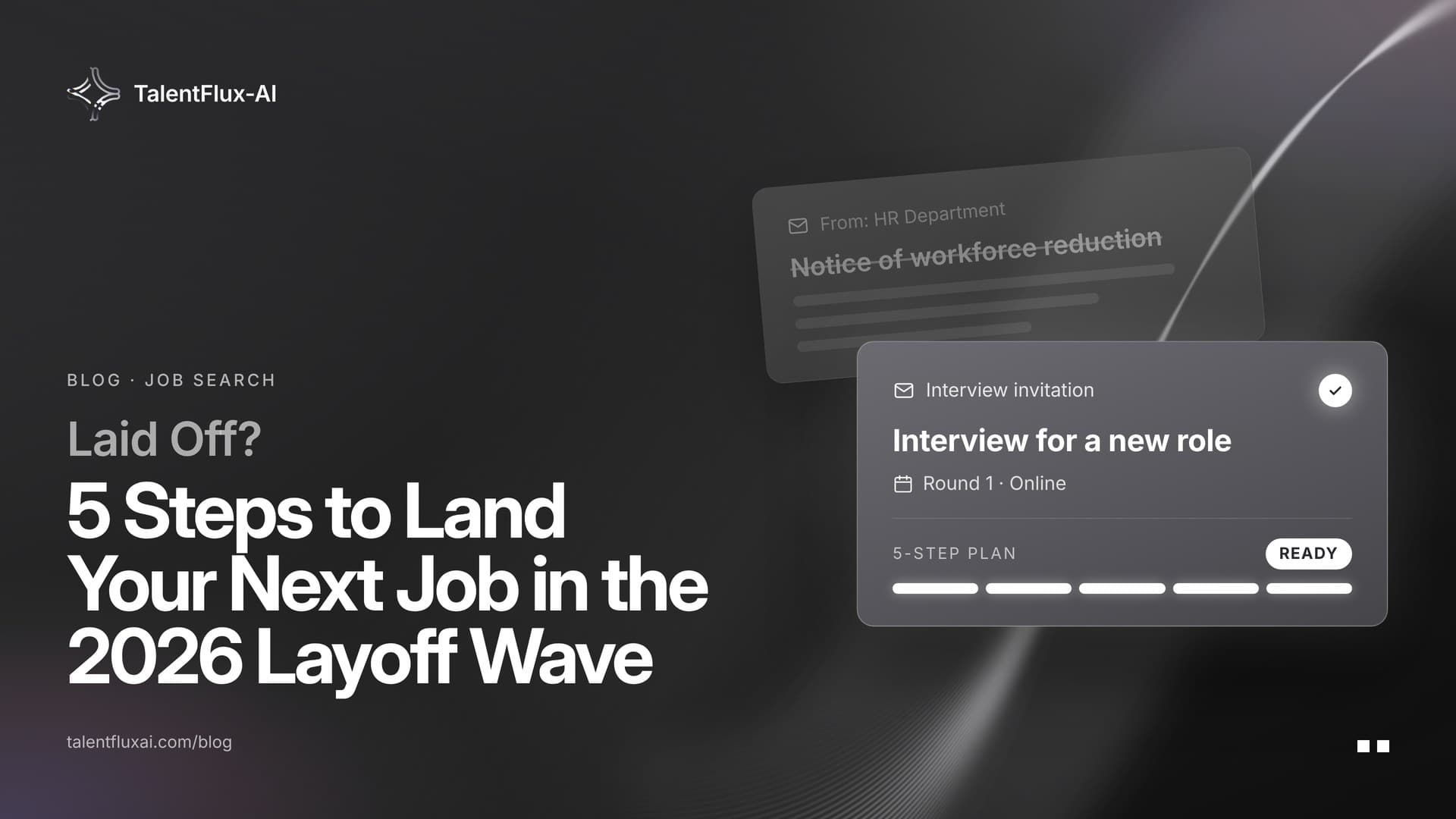
Laid Off? 5 Steps to Land Your Next Job in the 2026 Layoff Wave
The 2026 layoff wave: you are not alone
Getting a "workforce reduction" email is a shock for anyone. But in 2026, it has become a shared experience for a great many people, especially in tech.
According to Challenger, Gray & Christmas, US tech companies announced 171,501 job cuts from January to October 2026, up 21% year over year (compiled by ValueAdd VC). AI was cited as the reason for 121,401 cuts across all industries, more than double the 54,836 for all of 2025 (IBTimes).
In Vietnam, the overall picture is more stable: the Q3/2026 unemployment rate was 2.22%. However, unemployment among young people aged 15–24 rose to 9.07%, and to 12.49% in urban areas (General Statistics Office).
If you have just been laid off, what matters most is taking the right actions in the right order. Here are 5 steps to protect your rights and find a new job faster.
Step 1: Know your rights before you sign anything
Don't rush to sign a termination agreement. How the company records the reason for your exit directly affects the benefits you receive. The rules below apply to employees in Vietnam.
| Benefit | When you qualify | Amount |
|---|---|---|
| Job-loss allowance (Article 47, 2019 Labor Code) | Let go due to restructuring, technology changes or economic reasons; worked at least 12 months | 1 month's salary per year worked, minimum 2 months' salary |
| Unemployment benefit (2025 Employment Law) | Paid unemployment insurance for at least 12 months in the 24 months before leaving | 60% of average insured salary over the last 6 months, capped at 5× the regional minimum wage; paid for 3–12 months |
| Vocational training and job counseling support | Unemployment insurance participants | Free at public employment service centers |
Things to do right away:
-
Check the stated reason for termination. For cuts due to restructuring, the company must notify the provincial People's Committee and employees 30 days in advance.
-
Collect all documents: termination decision, finalized social insurance book, income confirmation.
-
File for unemployment benefits early. Payments start on the 11th working day after you submit a complete application. There is a filing deadline, so confirm it with the public employment service where you live.
-
Negotiate extras if you can: unused leave days, outstanding bonuses, a reference letter.
Step 2: Stabilize your finances and mindset
A job search can take several months, so make a financial plan before you send your first application.
Finances:
- Add up every source of money: savings, job-loss allowance, expected unemployment benefits.
- Divide by your minimum monthly spending to see how many months of "runway" you have.
- Cut non-essentials: subscriptions, installment purchases, risky investments.
- If your runway is under 3 months, consider freelance or part-time work while you search for your main role.
Mindset: a layoff is usually a company cost-cutting decision, not a verdict on your ability. Give yourself a few days to rest, talk to people close to you, then keep a regular daily routine as if you were going to work. Treating the job search as a project with weekly goals will help you feel less anxious.
Step 3: Refresh your CV for the age of AI screening
Your CV is now read by AI before it reaches a recruiter. According to Greenhouse data compiled by Novorésumé, 53% of US recruiters have handed most CV screening to AI or ATS tools. When humans do read, 42% spend under 10 seconds on the first pass.
So your CV needs to work for both machines and people:
-
Keep the layout simple: one column, common fonts, no text inside images or complex tables. AI reads text-based PDFs better than scans.
-
Use the job description's language: if the posting says "project management", use that phrase rather than just "PM".
-
Quantify achievements: "grew online sales 35% in 6 months" is more convincing than "responsible for online sales".
-
Tailor your CV to each role: one generic CV sent everywhere will score low on fit.
-
Be upfront about the gap: write briefly "role eliminated in 2026 restructuring". In a layoff wave, recruiters understand.
Don't forget to update LinkedIn and turn on "Open to Work" so recruiters can find you.
Step 4: Activate your network and diversify your channels
Applying only through job boards is the slowest route. Many good roles are filled through internal referrals before they are ever posted publicly.
Channels to use:
-
Former colleagues and managers: send a short message stating the role you want and asking for a referral.
-
LinkedIn: post a brief, positive update that you are looking for new opportunities, with your key skills.
-
Industry communities: Facebook groups, professional events, tech meetups.
-
Headhunters: best suited to mid-level management roles and above.
-
Public employment service centers: where you file for unemployment benefits, they also offer free job counseling and referrals.
Tip: set concrete weekly goals, for example 10 quality applications and 5 conversations with people in your field. Log every application in a tracker so you never miss an interview.
Step 5: Upskill, especially in AI
AI is behind many of the cuts, but it is also a skill employers increasingly demand. The time between jobs is a good chance to learn.
-
Use AI in your own field: marketers can learn AI for content and data analysis; accountants can automate reporting; developers can learn to work with AI coding tools.
-
Pick short courses with a tangible output: one small project on your CV is worth more than several certificates with no concrete results.
-
Use the training support from unemployment insurance: if eligible, you can get support for vocational training and upskilling costs.
-
Consider an adjacent move: for example, from customer support to running AI chatbots, or from recruiting to HR analytics.
In interviews, be specific about what you learned and built during your break. That turns the gap in your CV into a plus.
Job hunt smarter with TalentFlux-AI
When software reads your CV before a recruiter does, candidates need AI on their side too. TalentFlux-AI is an AI platform connecting job seekers with employers and HR teams, supporting you at every step of the job search.
If you have just been laid off, TalentFlux-AI's tools map directly onto the steps above:
-
AI Resume Builder: create an ATS-friendly CV from templates and turn bullet points into measurable achievements
-
AI Resume Review: score each section of your CV and flag keywords missing from the job posting
-
AI Cover Letter Generator: draft cover letters from your CV and the job description
-
AI Mock Interview: practice with a voice AI interviewer whose questions are based on the job description and your CV, then get a feedback report
-
Smart job search: rank openings by fit with your CV and track your applications, across 550,000+ positions from 13,000+ companies
Start free with TalentFlux-AI: build an ATS-ready CV and find the right job today at talentfluxai.com/careers.
Layoff FAQ
Can I receive both the job-loss allowance and unemployment benefits? Yes, if you qualify. The job-loss allowance is paid by your employer for working time not covered by unemployment insurance. Unemployment benefits are paid by the unemployment insurance fund.
Should I sign the "mutual termination agreement" my company offers? Read it carefully before signing. If it says you are leaving voluntarily, your benefits may differ from a restructuring layoff. If in doubt, ask your trade union or a labor lawyer.
How should I explain the layoff in interviews? Briefly and honestly: your role was eliminated in a restructuring. Then move on to your achievements and what you have learned since.
How soon should I start looking for a new job? As soon as you understand your benefits and have taken a few days to rest. Starting early gives you more options before your financial runway runs out.
Conclusion
A layoff is not the end of your career. Knowing your rights, keeping your finances stable, refreshing your CV, activating your network and building AI skills are 5 steps that help you return to the market stronger than before.
Legal information in this article is for reference only and applies to Vietnam; check the original legal texts or ask the social insurance agency or public employment service when filing.
Sources
-
ValueAdd VC – Tech Layoffs by Year 2020–2026 (Challenger, Gray & Christmas data)
-
General Statistics Office of Vietnam – Labor and employment, Q3 and 9 months of 2026 (Vietnamese)
-
LuatVietnam – 10 new unemployment insurance rules from 01/01/2026 (Vietnamese)
-
Thu Vien Phap Luat – How the job-loss allowance is calculated (Vietnamese)