After a job interview, sending a thank-you email is a small but meaningful step that can help you leave a positive impression and maintain a connection with the employer. The best time to send a thank-you email is within 24 hours of your interview.
So, what should you include in a post-interview thank-you email? When should you send it, and what should you avoid? This guide covers everything you need to know, along with three professional thank-you email templates you can customize for different interview situations.
1. Should You Send a Thank-You Email After an Interview?
Yes. Sending a thank-you email after an interview is a good professional practice, whether your interview takes place in person, over the phone, or online.
While a thank-you email does not guarantee a job offer, it gives you another opportunity to demonstrate professionalism, reinforce your interest in the position, and leave a positive impression on the hiring team.
Here are three key benefits:
- Show professionalism: A thoughtful thank-you email demonstrates courtesy, initiative, and genuine interest in the opportunity.
- Stay memorable: Referring to a specific detail from your conversation can help the interviewer remember you among other candidates.
- Reinforce your qualifications: You can briefly highlight a relevant skill, experience, or achievement that aligns with the role.
Although not every employer expects a follow-up email, sending one is a simple habit that can strengthen your overall job application experience.
2. When Should You Send a Thank-You Email After an Interview?
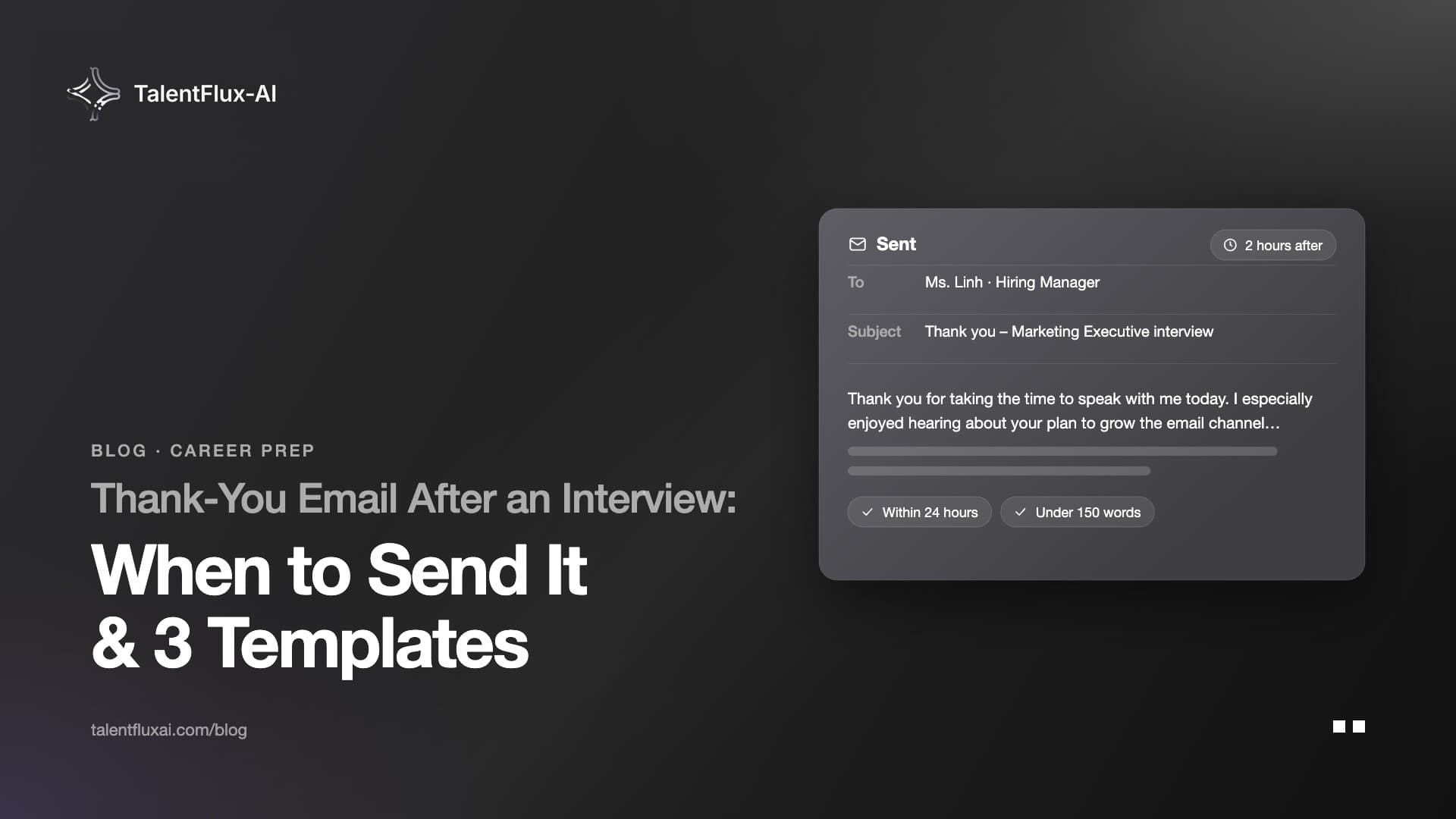
The best time to send a post-interview thank-you email is within 24 hours of your interview, ideally on the same day.
Here are some situations to consider:
- Morning or early afternoon interviews: Send your email shortly after the interview ends.
- Late afternoon interviews: Sending it the following morning is perfectly acceptable.
- Friday afternoon interviews: You can send it on Monday morning if you are unable to send it on Friday.
- Multiple interview rounds: Consider sending a separate thank-you email after each round, especially when meeting different interviewers.
If you interview with several people, sending individual emails allows you to personalize your message. If you only have the recruiter's email address, you can send one message and ask them to pass your thanks along to the interview panel.
3. How to Write a Professional Thank-You Email After an Interview
A professional thank-you email should be concise, ideally around 100–150 words. It should include five essential elements: a clear subject line, a thank-you message, a specific interview detail, a brief statement of your qualifications, and a professional closing.
3.1. Write a Clear Subject Line
Your subject line should help the recruiter quickly identify who you are and which position you interviewed for.
A simple formula is:
Thank You – [Job Title] Interview – [Full Name]
Example: Thank You – [Marketing Executive] Interview – [Full Name].
3.2. Start With a Thank-You Message
Begin by thanking the interviewer for their time and the opportunity to discuss the position.
For example:
"Dear [Interviewer's Name],
Thank you for taking the time to speak with me today about the [Job Title] position at [Company Name]."
3.3. Mention a Specific Detail From the Interview
This is what makes your email feel personal rather than like a generic template.
You can mention:
- A company project or business initiative discussed during the interview.
- A challenge the team is currently working to address.
- Something you learned that made you more interested in the position.
3.4. Reinforce Why You Are a Good Fit
Briefly connect something discussed during the interview to your relevant experience or skills.
You do not need to repeat your entire resume. Focus on one or two qualifications that best match the role.
3.5. Close With Appreciation and Your Contact Information
Express your continued interest in the opportunity and your willingness to provide any additional information if needed.
End the email with your full name and phone number so the recruiter can easily contact you.
4. Three Professional Post-Interview Thank-You Email Templates
Below are three thank-you email templates for common interview situations. You can copy and customize the information in square brackets to match your specific interview.
Template 1: Thank-You Email After the First Interview
When to use: After an initial interview with HR or the hiring manager, when you want to express your interest and reinforce your qualifications.
Subject: Thank You – [Job Title] Interview – [Full Name]
Dear [Interviewer's Name],
Thank you for taking the time to speak with me today about the [Job Title] position at [Company Name].
I particularly enjoyed learning about [Company Project/Business Direction]. With my experience in [Relevant Skill/Experience], I believe I could make a positive contribution to your team.
I remain very interested in the opportunity and look forward to hearing about the next steps in the recruitment process.
Best regards,
[Full Name]
[Phone Number]
Template 2: Thank-You Email After the Final Interview
When to use: After a final-round interview with senior management, company leadership, or the final decision-maker.
Subject: Thank You – Final Interview for [Job Title] – [Full Name]
Dear [Interviewer's Name],
Thank you for taking the time to meet with me and share more about [Company Name]'s future direction during today's interview.
I was particularly interested in learning about [Project/Business Plan/Strategic Direction]. With my background and experience in [Relevant Professional Field], I believe I could contribute meaningfully to the team's goals.
I truly appreciate the opportunity to learn more about the role and the organization. I would be excited to have the chance to contribute to your team.
Best regards,
[Full Name]
[Phone Number]
Template 3: Thank-You Email With Additional Information
When to use: When you forgot to mention an important qualification, want to share your portfolio, or need to provide additional materials related to an interview question.
Subject: Thank You – [Job Title] Interview – [Full Name]
Dear [Interviewer's Name],
Thank you for taking the time to interview me and share more about the [Department/Team Name] this morning.
Following our conversation, I would like to add some information regarding your question about [Relevant Topic]. In a previous project, I had the opportunity to [Briefly Describe Relevant Project/Experience].
For your reference, I have included a link to my work: [Portfolio/Project Link].
I hope this additional information provides a clearer picture of my experience and qualifications. Thank you again for your time, and I look forward to hearing from you.
Best regards,
[Full Name]
[Phone Number]
Note: Replace all bracketed information with details relevant to your actual interview. Avoid including achievements or experience that do not accurately reflect your background.
5. Common Mistakes to Avoid When Sending a Thank-You Email
To make a positive impression, avoid these common mistakes:
| Common Mistake | How to Avoid It |
|---|---|
| Using a vague subject line | Include the job title and your full name |
| Sending a generic, copy-pasted message | Mention at least one specific detail from the interview |
| Writing an overly long email | Keep it concise, ideally around 100–150 words |
| Misspelling the interviewer's or company's name | Double-check all details before sending |
| Pressuring the recruiter for a decision | Simply express your interest in hearing about the next steps |
| Repeating your entire resume | Highlight only one or two relevant qualifications |
An effective thank-you email does not need to be complicated. Sincerity, clarity, and personalization matter more than elaborate wording.
6. What Should You Do If You Haven't Heard Back After Your Thank-You Email?
If you have sent a thank-you email but have not received a response, there is no need to worry immediately. The hiring team may need more time to evaluate candidates or complete internal recruitment procedures.
Here are three steps you can take:
Step 1: Wait Until the Expected Decision Date
If the recruiter provided an estimated timeline, wait until that date before following up. Avoid asking for an update immediately after sending your thank-you email.
Step 2: Wait Another 2–3 Business Days
If the expected timeline has passed and you still have not received an update, you can send a polite follow-up email to check on the recruitment process.
Step 3: Maintain Professional Communication
If you still receive no response, consider sending one final follow-up after approximately 5–7 business days. In the meantime, continue exploring and applying for other opportunities rather than putting your job search on hold.
Sample Follow-Up Email After an Interview:
Subject: Follow-Up – [Job Title] Interview – [Full Name]
Dear [Interviewer's Name],
I hope you are doing well.
I am writing to kindly follow up on the interview for the [Job Title] position at [Company Name] on [Interview Date].
I remain very interested in this opportunity and would appreciate any updates regarding the recruitment process. Please let me know if you need any additional information from me.
Thank you for your time and consideration. I look forward to hearing from you.
Best regards,
[Full Name]
[Phone Number]
7. How to Prepare Better for Your Next Job Interview
Sending a thank-you email is a valuable final step in the interview process. However, thorough preparation before meeting the recruiter remains one of the most important factors in presenting yourself as a strong candidate.
Here are some resources to help you prepare:
- Review common interview questions: Explore 20 Common Interview Questions and How to Answer Them Effectively to prepare clear and structured responses about your skills and experience.
- Prepare for online interviews: Use our Online Interview Preparation Checklist to check your equipment, interview environment, and professional presentation.
- Practice with AI: Try AI Mock Interviews: 4 Steps to Prepare for Your Next Interview to practice speaking based on real job descriptions (JDs) and receive feedback after each session.
With TalentFlux-AI, you can practice answering interview questions, improve your communication, and build confidence before meeting potential employers.
Explore free AI-powered tools for job searching and interview preparation at TalentFlux-AI.
8. Frequently Asked Questions About Post-Interview Thank-You Emails
8.1. Is it necessary to send a thank-you email after an interview?
It is not mandatory, but it is highly recommended. A thank-you email demonstrates professionalism, courtesy, and continued interest in the position.
8.2. How soon should you send a thank-you email after an interview?
Ideally, send your email within 24 hours of the interview. Sending it on the same day or the following morning is generally appropriate.
8.3. Should you send a thank-you email after an online or phone interview?
Yes. Whether your interview takes place in person, online, or over the phone, sending a thank-you email is a thoughtful way to show appreciation for the interviewer's time.
8.4. What if you don't have the interviewer's email address?
You can send your thank-you email to the HR representative or recruiter who arranged the interview and politely ask them to forward your message to the interviewer.
8.5. How long should a post-interview thank-you email be?
Ideally, keep your email around 100–150 words, organized into two or three short paragraphs. Focus on expressing gratitude, mentioning one memorable detail from the conversation, and reinforcing your interest in the position.
8.6. Can you send a thank-you message on LinkedIn instead of email?
Yes, particularly if you have already connected with the interviewer on LinkedIn. However, email remains the more appropriate and professional option in most recruitment situations.
8.7. What should you do if the recruiter doesn't reply to your thank-you email?
You do not need to resend your thank-you email. Wait until the expected decision date. If the deadline has passed by 2–3 business days, consider sending a polite follow-up to ask about the recruitment timeline.
Conclusion
A post-interview thank-you email may not determine the final hiring decision, but it is a simple way to demonstrate professionalism and leave a positive impression on potential employers.
Send your email within 24 hours, keep it concise, and personalize it based on your conversation. Most importantly, continue developing your skills and preparing for the next career opportunity.