How to Read a Job Description: 5 Steps to Know If You're a Fit Before You Apply
Many job seekers skim the job title and salary, then hit apply. They send dozens of applications but rarely hear back, because their CV doesn't match what the employer actually needs.
A job description (JD) tells you what the daily work looks like, which skills matter most and what your CV should highlight. Reading it carefully for five minutes before you apply helps you choose the right jobs and tailor your CV in the right places.
This article walks you through reading a job description in 5 steps, how to tell must-have requirements from nice-to-haves, and the warning signs to watch for.
1. Why read a job description carefully?
Job description: a description of an open role, covering the work involved, candidate requirements, benefits and how to apply.
Reading the JD carefully helps you answer 3 questions before you apply: can I do this job, do I want this job, and what should my CV highlight?
Read the JD → Compare with your profile → Decide to apply → Tailor your CV → Apply
2. The main parts of a job description
| Section | What it usually includes | What to look for |
|---|---|---|
| Company overview | Industry, size, culture | Whether the environment suits you |
| Responsibilities | Day-to-day tasks | Which tasks come first and appear most often |
| Requirements | Skills, experience, qualifications | Which are must-haves and which are nice-to-haves |
| Benefits | Salary, perks, training | Whether the details are clear and specific |
| How to apply | Email, link, deadline | Specific rules for the email subject or file name |
3. 5 steps to read a job description
Step 1: Read the responsibilities first, the requirements second
The responsibilities tell you what you will do every day. If these tasks are not what you want to do, there is no need to read the requirements.
Step 2: Underline skills that appear more than once
Skills that show up in both the responsibilities and the requirements are usually the most important. These are the keywords your CV should include.
Step 3: Split the requirements into two groups
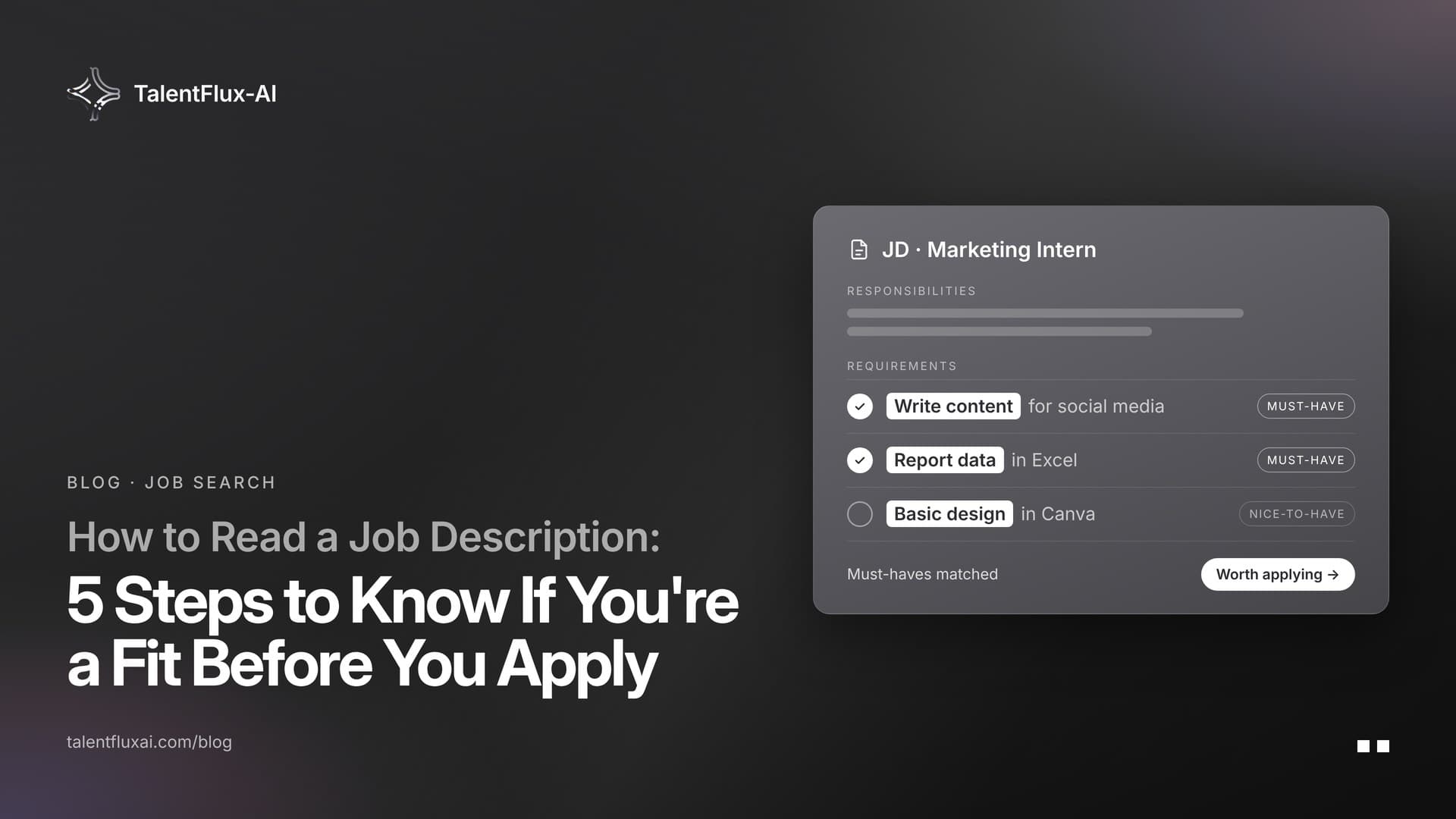
Separate must-haves from nice-to-haves. If you meet most of the must-haves, it is still worth applying even if you don't have every nice-to-have.
Step 4: Match them with your experience
For each key requirement, find something you have done that proves it: a university project, a part-time job, a club activity. Note any requirement without an example so you can prepare an answer for the interview.
Step 5: Note what you need to ask
Write down anything unclear, such as work location, working hours or the hiring process, and ask about it in the interview instead of guessing.
4. Must-have vs. nice-to-have requirements
- Must-have requirements: often come with words like "required", "proficient in" or "at least". These are what you need to do the job.
- Nice-to-have requirements: often come with words like "preferred", "a plus" or "bonus". Missing a few of these can still get you an interview.
- Years of experience: for entry-level roles, this number is sometimes flexible if you can show the skill through real projects.
5. Warning signs in a job ad
- Vague job description: only general phrases like "office work, high income".
- Requests for payment: application fees, training fees or a deposit before you start.
- Unusual income promises: pay far above the market with no experience needed.
- Unclear contact details: only a personal phone number or a social media account, with no specific company name.
6. Prepare your application with TalentFlux-AI
Once you have read the job description carefully, the next step is to tailor your CV to the skills the JD asks for. See also 8 common CV mistakes and how to fix them and how to keep track of every application when you apply to many jobs.
TalentFlux-AI's AI Resume Review gives feedback on each section of your CV and points out the lines to fix before you apply.
👉 Check your CV for free with AI Resume Review
FAQ: Common questions about reading job descriptions
Should I apply if I don't meet every requirement?
Yes, if you meet most of the must-haves. Use your CV and cover letter to show you can learn the missing parts quickly.
Should I use one CV for every job?
No. Keep a master CV, then adjust the summary and the order of your experience for each job description.
What if the job ad doesn't mention salary?
Check market pay for similar roles and ask about the salary range in the first interview.
Conclusion
Reading a job description carefully doesn't take long, but it helps you send fewer applications that work better.
- Read in the right order: responsibilities first, requirements second.
- Pick the right jobs: if you meet most must-haves, apply.
- Tailor in the right places: bring the most repeated skills into your CV.
One application prepared for a specific job always stands out more than dozens sent out in bulk.