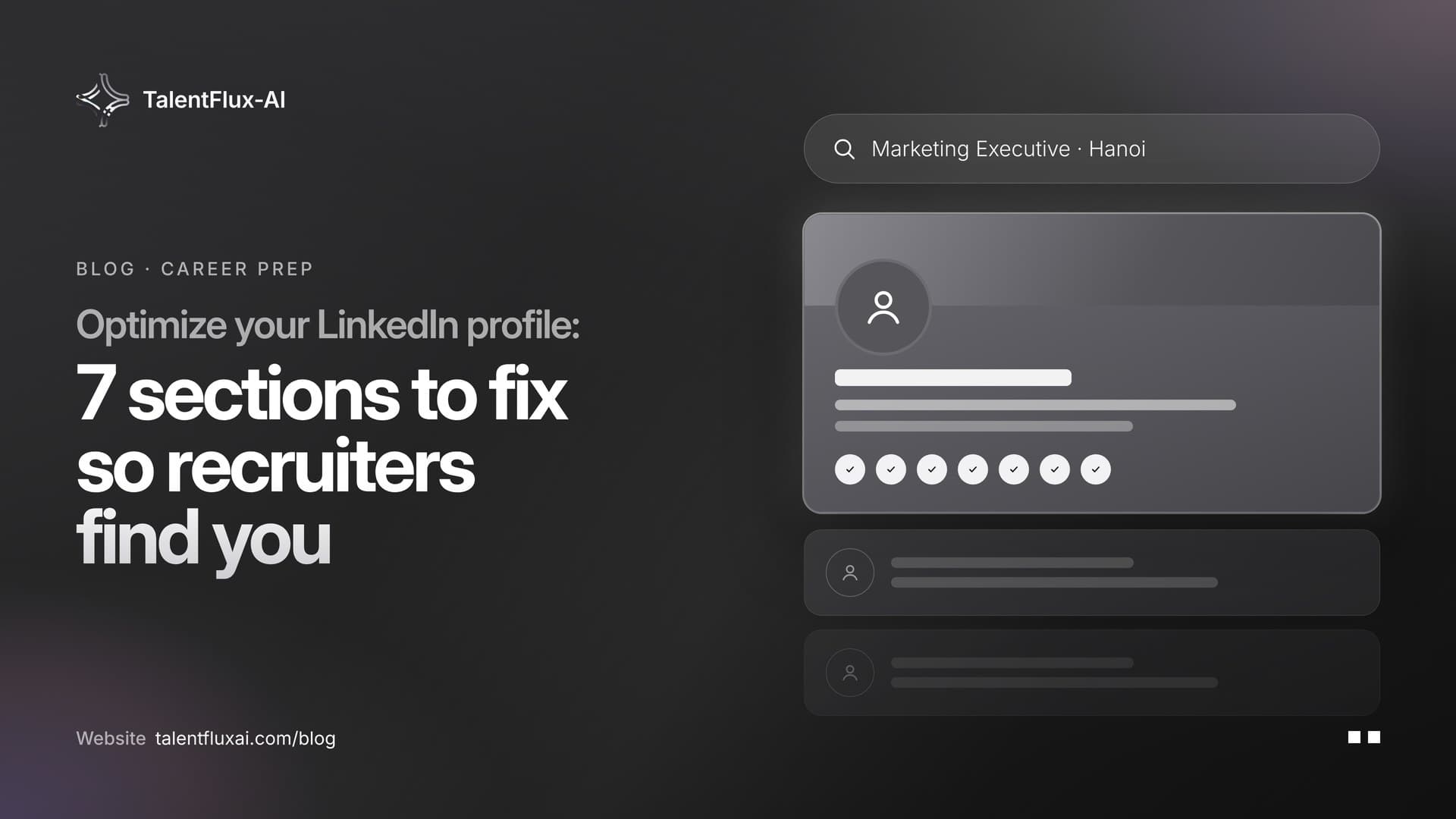
Optimize Your LinkedIn Profile: 7 Sections to Fix So Recruiters Find You
Many recruiters search for candidates directly on LinkedIn instead of waiting for applications to come in. If your profile is missing information or written in vague terms, you'll have a hard time showing up in their search results.
A well-prepared LinkedIn profile works like a CV that's always open: recruiters can see who you are, what you can do and what job you're looking for.
This article shows you how to optimize 7 key sections of your LinkedIn profile, with examples and common mistakes beginners make.
1. Why does your LinkedIn profile matter in a job search?
LinkedIn profile: your public professional page, including your photo, headline, About section, experience, education and skills.
Recruiters usually search for candidates using keywords for job titles and skills. A profile with the right keywords and complete information is easier to find and more likely to be opened.
Recruiter searches → Sees your photo and headline → Opens your profile → Reads your About and experience → Reaches out
2. 7 sections to optimize on your LinkedIn profile
1. Profile photo
Use a clear photo of your face, with a simple background and work-appropriate clothing. A profile with a photo feels more trustworthy than one left blank.
2. Background photo
Choose an image related to your field, or a simple design that shows the role you're aiming for.
3. Headline
Recruiters find candidates on LinkedIn by keyword, and your headline is one of the first places the system reads. It also appears right under your name in search results, so it's the line that decides whether they click on your profile. "Final-year student" matches almost no keywords. Use this formula instead: Target role | 1–2 key skills | What sets you apart.
Example: Data Analyst Intern | SQL, Power BI | Final-year Economics student. You have up to 220 characters, enough to include the words recruiters often search for.
4. About
Before clicking "See more," viewers only see the first few lines, so your opening sentence needs to say right away who you are and what you can do. Don't open with generic lines like "I'm dynamic and eager to learn." Write 3–5 sentences in this order:
- The field you're studying or working in.
- Your standout skills.
- One concrete result with a number.
- The job you're looking for.
Write in the first person, weave in keywords for your target role naturally, and end with your email so recruiters can contact you right away.
5. Experience
Recruiters usually skim each role for just a few seconds, so don't copy the job description. Each line should follow this pattern: action verb + what you did + result.
Example: instead of "In charge of the club fanpage," write "Planned and wrote 40 posts for the club fanpage, doubling average engagement in one semester."
If you don't have formal experience yet, school projects, part-time jobs and club activities all count, as long as they show clear results. Add skills to each role so your profile matches more searches.
6. Skills
Many recruiters filter candidates by skill, so how you name a skill matters as much as having it. Open 5–10 job postings for the role you want, note the skills that come up most often, then use the exact names from those postings.
Pin your most important skills to the top, and remove skills unrelated to your career direction. Ask classmates or former managers to endorse a few key skills to make your profile more credible.
7. Open to Work status
Turn on your job-seeking status and specify the roles, locations and work arrangements you want. You can choose to show it to recruiters only.
The table below compares weaker and stronger ways to write the 3 most important sections:
| Section | Weaker | Stronger |
|---|---|---|
| Headline | Final-year student | Content Marketing Intern | SEO Content · Social Media | Final-year Marketing student |
| About | I'm dynamic, enthusiastic and eager to learn | State your field, standout skills, one concrete result and the role you're looking for |
| Experience | Supported the marketing team | Wrote 3 posts a week for the club fanpage; engagement grew after 2 months |
3. Be active on LinkedIn to get noticed
- Connect selectively: start with classmates, lecturers, former colleagues and people working in the field you're interested in.
- Share what you learn: a short post about a project, course or event you took part in.
- Leave meaningful comments: add specific thoughts to industry posts instead of just clicking Like.
- Follow target companies: to keep up with their job openings and understand their culture before you apply.
4. Common mistakes
- Empty profile or no photo: recruiters can't assess you and are likely to skip your profile.
- Headline too generic: with no keywords for a role or skill, you're unlikely to show up in searches.
- Information doesn't match your CV: job titles or dates differ between your CV and LinkedIn.
- Not updated for a long time: new experience and skills haven't been added.
5. Prepare your job application with TalentFlux-AI
Your LinkedIn profile and CV should tell the same story. If you don't have much experience yet, see how to write a CV that highlights your skills when you have little experience.
TalentFlux-AI's AI Resume Builder helps you create a clear, well-structured CV to use alongside your LinkedIn profile.
👉 Create your CV with AI Resume Builder
FAQ: Common questions about LinkedIn profiles
Should students with no experience create a LinkedIn profile?
Yes. You can include school projects, club activities, certifications and skills you've learned. The more complete your profile, the easier it is to find.
Should I write my LinkedIn profile in Vietnamese or English?
If you're targeting foreign companies or roles that require English, write it in English. LinkedIn also lets you add a profile in a second language.
Should I make Open to Work public?
It depends on your situation. If you're currently employed and don't want your company to know, you can choose to show your status to recruiters only.
Conclusion
A good LinkedIn profile doesn't need to be long, but it does need to be clear and use the right keywords.
- Clear on the role: your headline states the exact job you're looking for.
- Clear on results: your experience shows specific work and numbers.
- Always up to date: add new skills and projects as soon as you have them.
Spending one session today to polish your profile can help recruiters find you for months to come.